Summary
Apple announced new 14- and 16-inch MacBook Pro models with a tandem OLED display and Touch input, alongside M5 Pro and M5 Max chips. US pre-orders begin October 28, with availability starting November 6.
Apple announced new 14- and 16-inch MacBook Pro models on October 28, 2026, introducing tandem OLED displays and Touch input on the Mac for the first time, according to the company. The laptops use Apple’s M5 Pro or M5 Max chips and are available to pre-order in 30 countries and regions, including the US. Apple says availability begins November 6.
A tandem OLED display built for visual work
The new display, which Apple calls PROLED XDR, uses two self-illuminating pixel layers. In tandem OLED displays, those emissive layers are arranged together in the panel; Apple says its panel design and display-processing algorithms are intended to improve brightness and grayscale uniformity while reducing internal reflections.
Apple specifies peak brightness of up to 2,000 nits for HDR and SDR, a 10,000,000:1 contrast ratio and an adaptive refresh rate from 10Hz to 120Hz. The display supports the P3 and Adobe RGB colour spaces, with more than 80 per cent Rec. 2020 coverage, according to Apple. Factory calibration and reference modes are aimed at colour-critical work such as photography, design and video grading. A nano-texture option is also available to reduce reflections.
The display engine adjusts each pixel’s colour and luminance, while ProMotion varies the refresh rate according to the content. Together, those features are intended to balance image clarity and smooth motion with power use. Apple describes the screen as a portable reference display, but its specifications and performance claims are the company’s own.
Touch input joins the Mac workflow
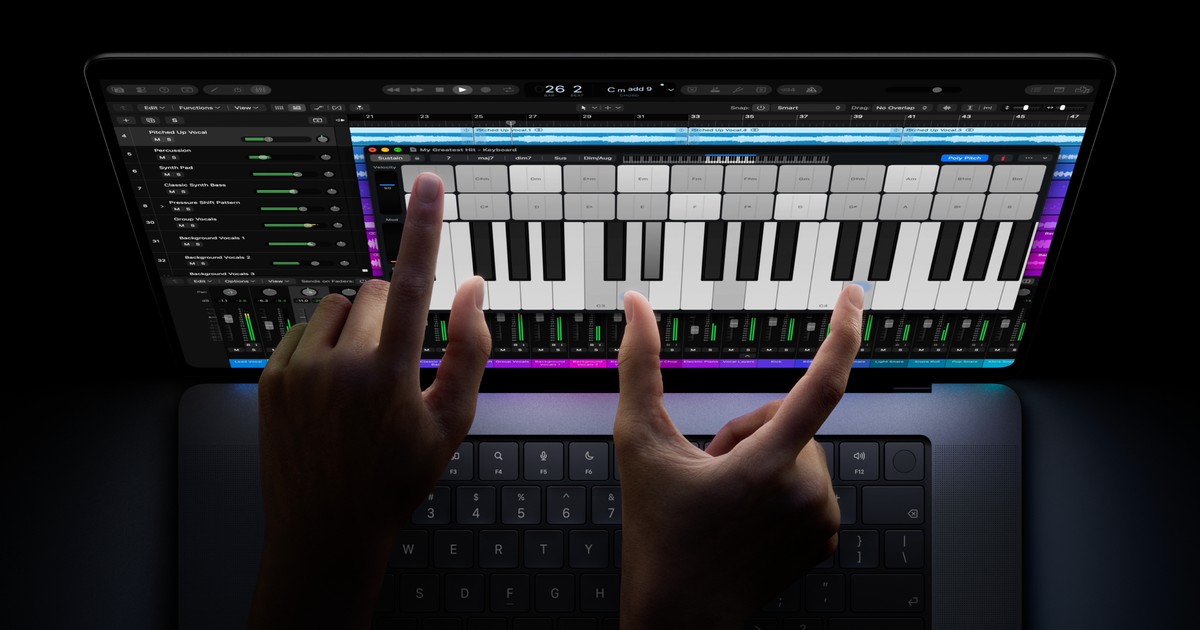
The MacBook Pro’s touch sensor is built into the display panel rather than placed as a separate layer on top, which Apple says reduces latency. Touch actions include scrolling, zooming, moving items and arranging windows. The company says the input works alongside the keyboard and trackpad, rather than replacing them.
Apple’s macOS can translate touches into clicks for many existing apps, while updated system gesture tools let developers build interfaces designed specifically for touch. Apple also lists creative uses such as drawing directly on the display, playing software instruments and editing video. Several named third-party apps are expected to add touch-focused features later in 2026.
The MacBook Pro also adds Dynamic Island, which Apple says will provide access to Spotlight search, Live Activities and Siri AI. Siri AI is in beta in macOS 27.2, according to the announcement, and availability depends on supported languages and other requirements.
M5 chips, thinner designs and US prices
Apple says the M5 Pro and M5 Max are designed for demanding workloads, including code compilation, video editing and local AI processing. The company says M5 Max can run large language models with hundreds of billions of parameters on the device. The laptops can be configured with up to 128GB of unified memory and up to 16TB of storage.
The 14-inch model weighs 3 pounds and the 16-inch model 4 pounds, according to Apple. The company also advertises up to 24 hours of battery life; its testing was conducted in September 2026, and battery life varies with use and configuration.
In the US, the 14-inch model with M5 Pro starts at $2,899 and the 16-inch at $3,399. M5 Max configurations start at $4,499 for the 14-inch model and $4,799 for the 16-inch model. These are US prices; Apple’s announcement identifies pre-orders in 30 countries and regions but does not provide a country-by-country price list.