Summary
ASUS says its two NVIDIA HGX Rubin NVL8 server designs are planned for launch in Q4 2026. The company also plans to use NVIDIA DSX Sim Blueprint to help simulate AI-factory infrastructure before deployment.
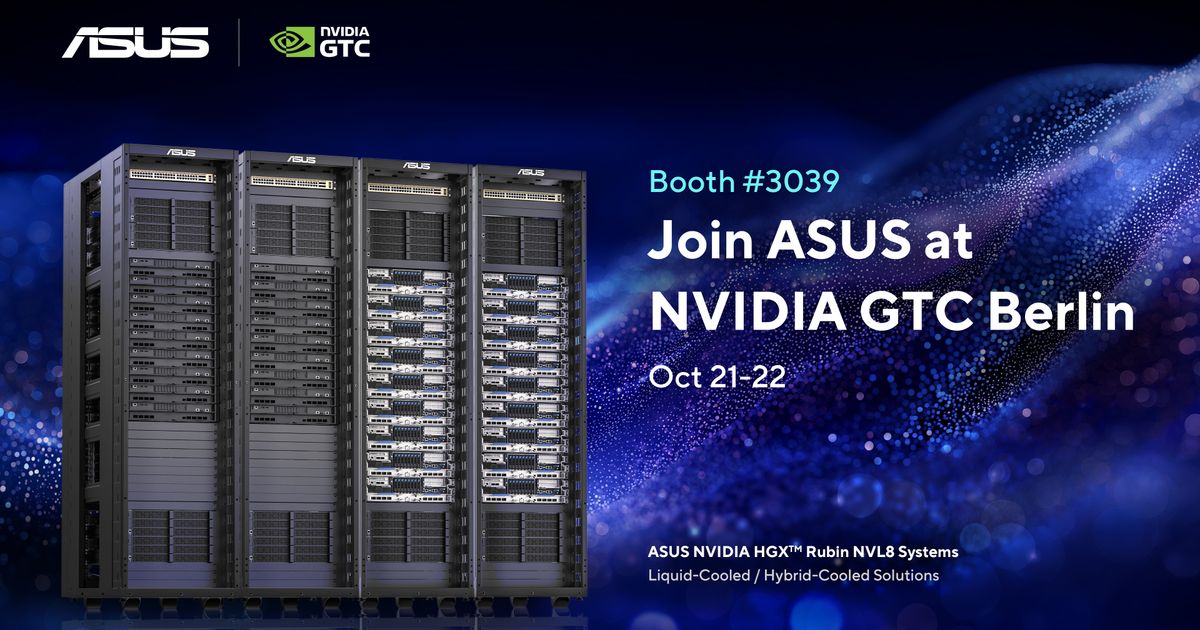
ASUS announced on October 21, 2026, that two server designs built around NVIDIA HGX Rubin NVL8 are planned for launch in Q4 2026. The 3U XR R1I12B-M1BHFS combines liquid cooling for its eight-GPU baseboard with air cooling for its processors; the 2U XR R1I12B-M1BLFS uses a fully liquid-cooled design. ASUS says the systems will be offered in partial-rack and full-rack configurations.
The announcement also describes a separate planning tool: ASUS will combine its system-engineering work with NVIDIA DSX Sim Blueprint to simulate AI-factory infrastructure in a digital-twin environment before deployment.
Two cooling approaches for HGX Rubin systems
The 3U XR R1I12B-M1BHFS uses direct-to-chip (D2C) liquid cooling for the NVIDIA HGX Rubin eight-GPU baseboard, while its two Intel Xeon 6 processors are air-cooled. ASUS says the air-cooled CPU sled can reduce maintenance time by up to 50%. The system also supports U.2 and E1.S storage options, according to the company.
The smaller 2U XR R1I12B-M1BLFS is fully liquid-cooled. ASUS describes it as designed for high computing density and improved power usage effectiveness (PUE), a measure comparing a data centre’s total energy use with the energy used by its IT equipment. The company also says the design uses NVIDIA validation and a cable-less board-to-board architecture to simplify system integration.
The two configurations offer different approaches to cooling and system layout within the same HGX Rubin NVL8 portfolio. That flexibility is relevant to data-centre operators planning for demanding AI workloads, where server cooling and facility infrastructure have to be considered together. ASUS has not supplied performance measurements for the new systems in this announcement.
Simulating an AI factory before deployment
An AI factory involves more than servers: compute, networking, storage, power, cooling and facility infrastructure all need to work together. ASUS says its work with NVIDIA DSX Sim Blueprint will let customers represent these elements in a digital twin, then evaluate configurations, identify constraints and optimise performance and efficiency before deployment.
The company says the simulation work will involve ecosystem partners Schneider Electric, AVEVA and IBM. It is intended to help assess infrastructure trade-offs, including those relevant to large-scale token generation. This shifts part of AI-factory planning into a virtual environment, where alternative designs can be assessed before they are built.
ASUS presented the server systems and simulation approach at NVIDIA GTC Berlin 2026. Its stated Q4 2026 launch timing is a plan; the announcement does not describe the systems as shipping now.