Summary
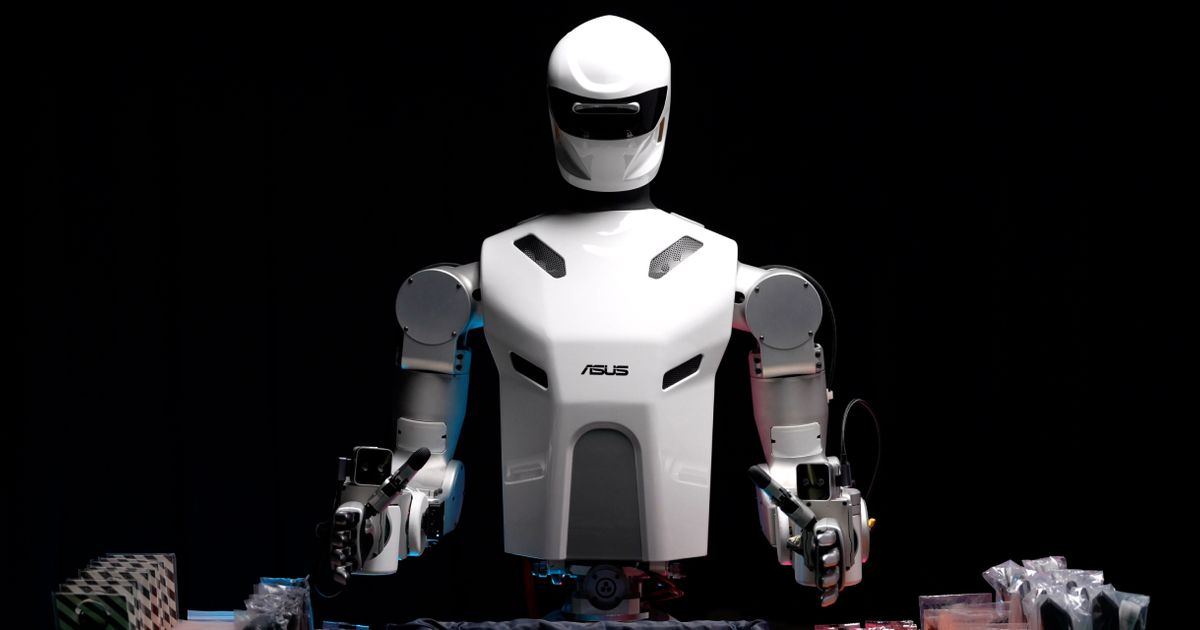
ASUS says its Gallop humanoid robot is learning to pack motherboard accessories at an electronics manufacturing station. Customer pilots are planned for 2027, with market availability targeted for the second half of 2028.
ASUS says its Gallop humanoid robot is learning a motherboard-accessory packing task at an ASUS group electronics manufacturing services (EMS) factory. The company describes the work as training on a real production station, with its tools, parts and quality requirements—not as a finished, fully autonomous factory deployment.
The station involves packing 15 small parts, many in thin, clear bags, and takes about 20 seconds per board. ASUS has set a target of 99.5% success within that time. That is a performance goal, not a result the company reports Gallop has already achieved. The robot program began in early 2026.
A workstation built for people
ASUS’s case for a humanoid form is that many factories are already arranged around human workers: stations, tools and trays are sized for people. A two-armed robot with dexterous hands could, in principle, work at those stations without requiring the factory to be redesigned around conventional automation. ASUS also notes that humanoids are not appropriate for every task; it is focusing on jobs where the form makes sense.
The selected packing task tests handling small, thin and soft items. ASUS says its standard is that the robot should take on most of the work, rather than require a person to remain beside it throughout the task. The company reports that the process of showing Gallop a task, teaching it and testing it on the production line is now in place.
How Gallop learns—and what comes next
ASUS says it starts with open AI models that already have general knowledge of how hands and objects behave, rather than developing a large foundation model of its own. Workers who consent wear small head cameras so the system can learn how the task is performed. Simulation creates variations on those examples, while an operator wearing a VR headset and gloves guides the robot through the job using the same parts and cameras as the station. ASUS says recordings made after deployment will also feed back into training.
The robot’s software is divided into four layers: a planner that interprets the scene and breaks the job into steps; a supervisor AI that checks progress and replans when needed; a skills layer for actions such as reaching and grasping; and a control layer that moves the arms and hands. ASUS says the layers use fixed interfaces so AI models can be replaced without rebuilding the robot. The system runs on one NVIDIA Jetson AGX Thor computer and uses standard robotics software.
Gallop currently operates from a fixed base with two arms. ASUS says its own dexterous hand, designed with a sense of touch, is still to be brought into the robot, and a wheeled version is planned next. The company describes pick-and-place work at a station as Gallop’s current strength.
ASUS plans to show Gallop to customers at Computex 2027 and says customer pilots are planned for 2027. It is targeting market availability in the second half of 2028. Electronics manufacturing is the initial focus; the company says it sees possible later applications in hospitals and service sites, where similar pick-and-place skills may be useful. Those are planned directions, rather than deployments described as already underway.