Summary
ASUS showcased ProArt laptops and a compact desktop powered by NVIDIA RTX Spark at IFA 2026, focusing on locally run AI agents and creative workflows. The company also demonstrated tools for image generation, media organisation and device control.
ASUS used its IFA 2026 media showcase in Berlin to present ProArt computers built around locally run artificial-intelligence workloads. The company said the event was its first global media event focused on AI agents and practical AI workflows running directly on ProArt PCs, rather than treating AI as a set of isolated software features.
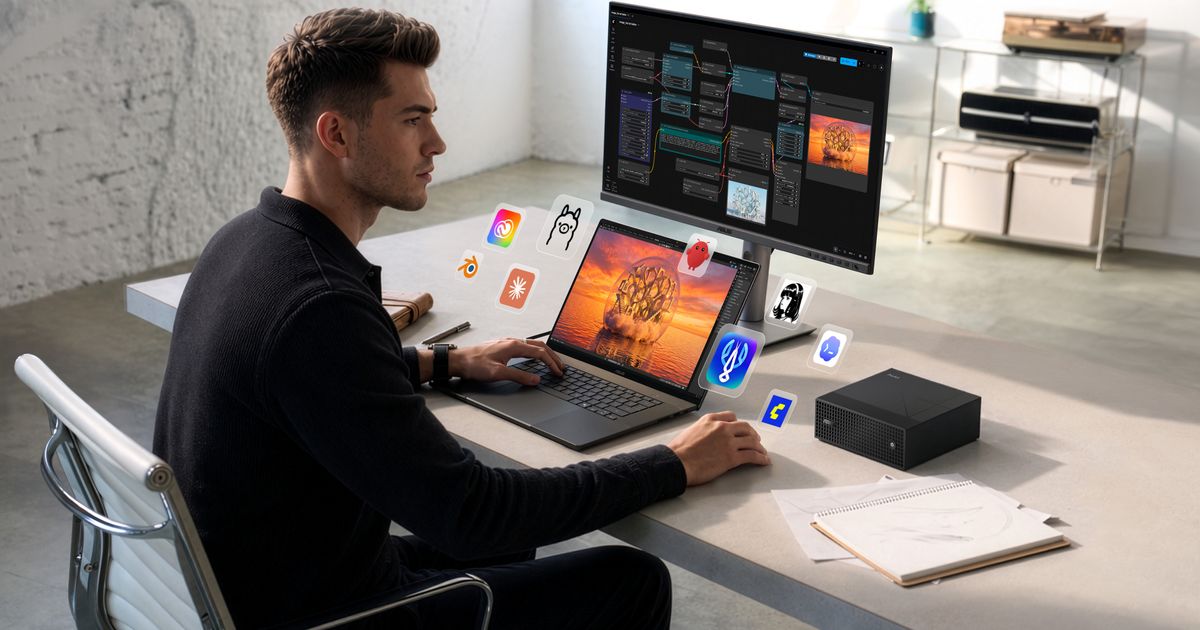
The showcased lineup included the ProArt P16 and P14 laptops, along with the compact ProArt GR1X desktop. ASUS described all three as being powered by NVIDIA’s RTX Spark platform and designed for creative applications, video production, design, 3D work and other advanced AI workloads.
ProArt devices target local creative workflows
The ProArt P16 is positioned as a mobile system for moving between ideation, content creation and production. The smaller ProArt P14 is aimed at creators who need portability while retaining local AI capabilities. ASUS described the ProArt GR1X as a compact system offering workstation-class performance for creators, workflow builders and people experimenting with agentic AI.
The announcement does not provide detailed processor or graphics configurations, memory capacities, benchmark results, prices or release dates for these products. Its claims are presented at the level of a product showcase and company demonstration rather than an independent performance test.
ASUS organised the showroom around seven interactive zones showing connected workflows from idea generation through editing, asset management and production. The demonstrations were intended to show how AI running on the computer could help creators work across several stages of a project while keeping control of the workflow on the device.
The software highlighted at the event included ASUS Zenni Claw, an AI-agent platform with ready-to-use ASUS skills, local-to-cloud routing and built-in safety protections. StoryCube was presented as an AI-powered hub for organising, managing and searching digital media. MuseTree supports token-free local image generation and creative ideation, while ProArt Creator Hub brings together device settings, colour management and workflow controls.
ASUS also highlighted collaborations with Google and Adobe, including bundled creative and AI services with selected ASUS laptops. These services are intended to support workflows that combine local processing with cloud-based tools.
Why ASUS is emphasising AI agents
ASUS’s keynote described agentic AI as a shift from software that waits for a user to initiate every action towards systems that can interpret intent, plan tasks, retrieve information, use tools, refine results and work on multiple tasks in parallel. In practical terms, an AI agent is software designed to coordinate several steps towards a requested outcome rather than returning a single response.
That model can require more computing resources than a single-purpose AI feature. ASUS specifically pointed to larger memory capacity, richer context windows and stronger local AI performance as requirements for increasingly capable agents. A context window is the amount of information an AI system can use while working on a task; larger windows can help it handle more instructions, files or project details at once.
The company identified predictable AI capacity, privacy and contextual awareness, and customisation as factors supporting personal AI computing. Running workloads locally can keep creative files and sensitive information closer to the device and give users more control over how AI features are configured. Those are ASUS’s stated benefits for local AI, and their practical value will depend on the final hardware, software support and individual workflow.
The event also extended ASUS’s AI messaging beyond ProArt. The company highlighted the ExpertBook Ultra, which combines AI performance with enterprise security and mobility, and the Zenbook 14, which brings AI-enhanced productivity features to a general-purpose portable computer. ASUS did not provide detailed specifications or availability information for those products in the announcement.