Summary
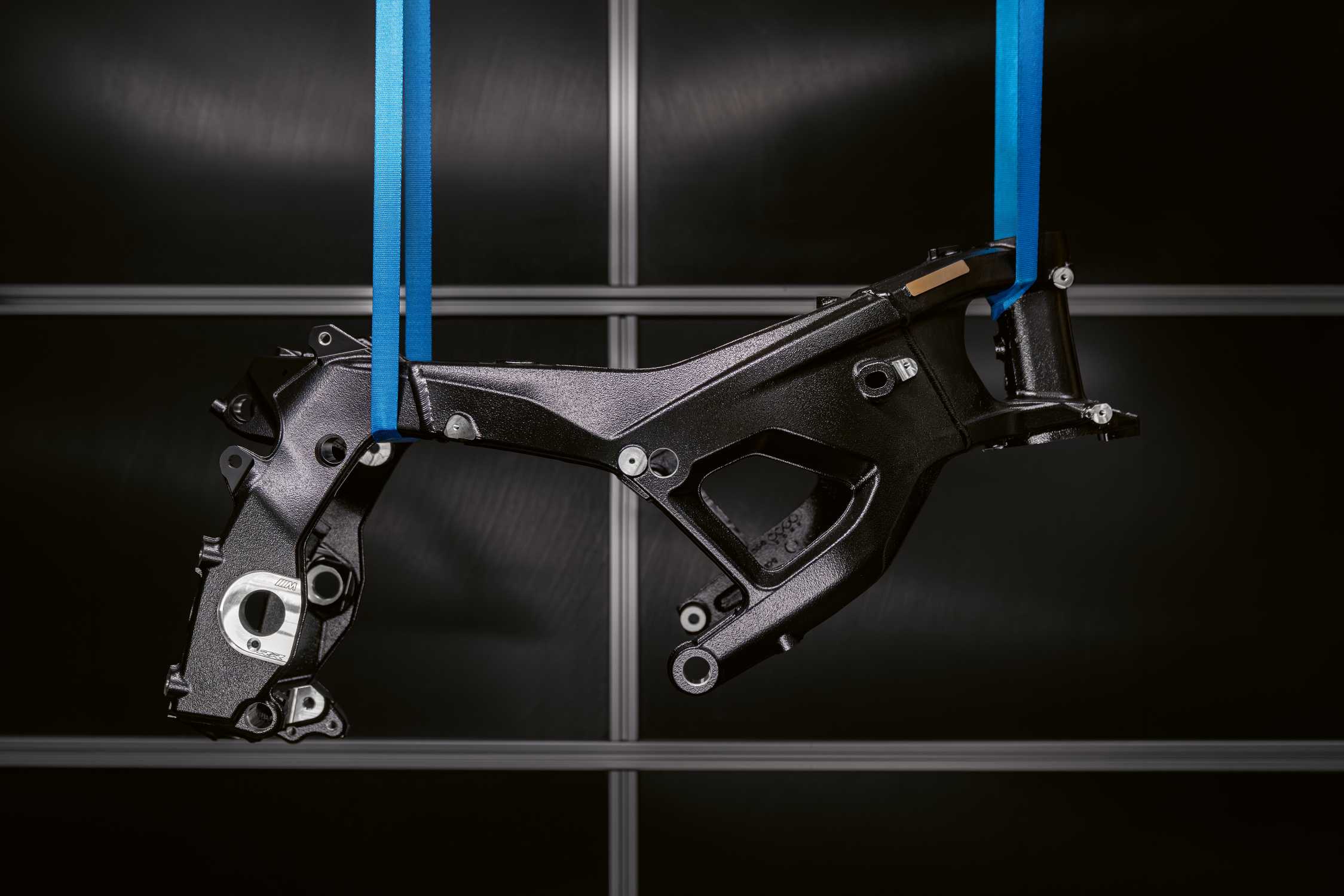
BMW says the third-generation M Motorsport frame will be standard on the M 1000 RR from model year 2027. It is around 1.3 kg lighter than the previous frame, with revised wall thicknesses intended to tune stiffness and flexibility.
BMW Motorrad says its third-generation M Motorsport frame will be fitted as standard to the BMW M 1000 RR from model year 2027. The aluminium frame is around 1.3 kg lighter than its predecessor, and revised wall thicknesses are intended to balance stiffness with controlled flexibility. BMW says the design draws on racing experience and is meant to improve handling precision, rider feedback and tyre contact, particularly during sporty riding and on track.
A frame designed for controlled flex
The frame has to transmit braking, steering and drive forces while supporting the motorcycle’s tyres as it changes direction and leans. BMW says the new design reduces wall thicknesses by up to 30 per cent in selected areas to tune how the structure responds to those loads.
At lean, the frame is designed to flex laterally by a defined amount. BMW says this movement can work alongside the suspension to absorb bumps, helping maintain tyre contact and provide clearer feedback. The company also says the revised frame retains high longitudinal stiffness, which is intended to support precise transfer of braking and drive forces.
BMW describes the expected results as more precise turn-in, more transparent responses and more consistent tyre contact. These are qualitative performance claims in the announcement; it does not report measured lap-time, handling or tyre-wear results. The stated weight reduction, by contrast, is a comparison with the previous frame.
From digital design to production
The frame’s development and manufacture are divided across BMW Motorrad’s Munich, Landshut and Berlin operations. Munich handles digital design, simulation and testing, including test-rig and riding tests. Landshut produces four thin-walled aluminium castings using low-pressure casting: the steering head, two side sections and the rear section.
In low-pressure casting, molten aluminium is fed into a mould in a controlled way. BMW says this helps limit turbulence and air inclusions. Temporary sand cores form internal cavities in the castings; the company also uses simulation to plan how those cores are made before manufacturing the tooling.
At the Berlin motorcycle plant, the four cast parts are TIG-welded into the frame, then coated for corrosion protection and machined to final dimensions. BMW says inspection includes X-rays, wall-thickness checks and coordinate measurements, with further measurement after the parts are joined. The company presents this digital-to-production process as a way to turn the frame’s targeted stiffness and flexibility into a reproducible series component.
The change brings a racing-derived chassis component to the production M 1000 RR, while also providing a platform for BMW’s factory and customer racing teams. For road-bike buyers, the confirmed change is the frame’s standard fitment from model year 2027; the claimed riding benefits will depend on the motorcycle’s performance in use.