Summary
BMW Group says its newly opened Irlbach-Straßkirchen plant has begun series production of sixth-generation high-voltage batteries, initially supplying the Munich factory for the new BMW i3. The company plans for the site to become a central battery supplier to its German vehicle plants.
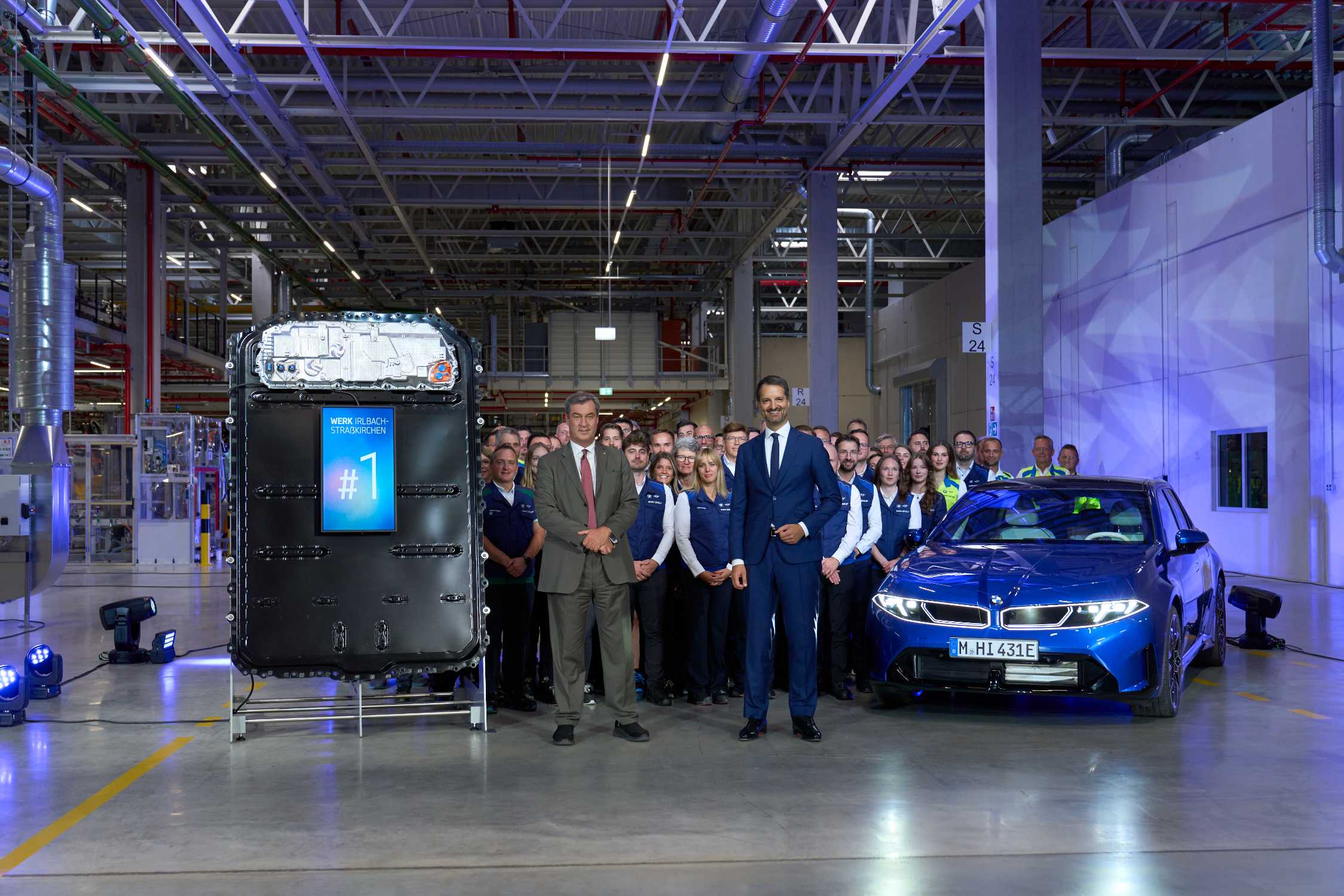
BMW Group says its new Plant Irlbach-Straßkirchen in Bavaria began series production on 1 October 2026, supplying sixth-generation (Gen6) high-voltage batteries to its Munich factory for installation in the new BMW i3. The company invested around one billion euros in the site and says production started two-and-a-half years after construction began in April 2024. Output began on a two-shift basis, with BMW attributing the faster-than-planned ramp-up to demand for Neue Klasse models.
The plant is intended to serve as a central battery-production site for BMW’s German vehicle factories. Its first deliveries to Munich put the facility into the supply chain for the new i3, rather than limiting it to pilot or pre-series manufacturing.
Production built around BMW’s Gen6 battery
The Gen6 batteries use cylindrical cells integrated directly into the high-voltage battery through a design BMW calls “cell-to-pack”. The battery housing also forms part of the vehicle’s body structure, an arrangement the company describes as “pack-to-open-body”. These features connect the plant’s battery assembly work with the structure of the vehicles that use the packs.
BMW says more than 3,500 data points are collected and monitored in real time for each battery. In-house-developed AI assistants and agents analyse production data, while 500 robots operate across a 50,000-square-metre production area. The company says these systems support quality control and production efficiency; each completed high-voltage battery also undergoes a full end-of-line inspection.
The facility produced its first pre-series battery in March 2026, less than two years after construction started. BMW says that, when fully operational, the plant will employ around 1,600 people and produce several hundred high-voltage batteries per day on two production lines. Those are figures for the plant at full operation, rather than its stated output at the start of series production.
A local battery network, with production claims to watch
Irlbach-Straßkirchen is one of five new high-voltage battery assembly facilities BMW says it is building near its vehicle plants worldwide. The company’s “local for local” approach is intended to keep battery and vehicle production close together. In Bavaria, the new site joins a network that BMW describes as spanning battery research, development, production and recycling.
BMW says the plant requires no fossil fuels for regular operations: an on-site photovoltaic system supplies part of its electricity, with additional energy sourced entirely from renewables. The company also says no water is required for assembling the high-voltage batteries. These claims concern the plant’s operations and assembly process; they should be distinguished from the wider resource and emissions footprint of making battery cells and vehicles.
For the Gen6 cells assembled into batteries for the i3, BMW says secondary materials are used for a portion of the cobalt, lithium and nickel. It reports that CO₂-equivalent emissions per watt-hour are approximately 33 percent lower than for the Gen5 cell used in the previous model. That comparison is for cell emissions per unit of energy, not a measure of the entire vehicle’s lifecycle emissions.
The opening marks the move from battery development and pre-series work to series supply for the Neue Klasse. The plant’s role will grow as BMW expands production, while the company’s stated full-operation staffing and output figures describe a later stage of that ramp-up.