Google DeepMind has introduced an agentic mode for video understanding in Gemini that changes how the model examines long videos.
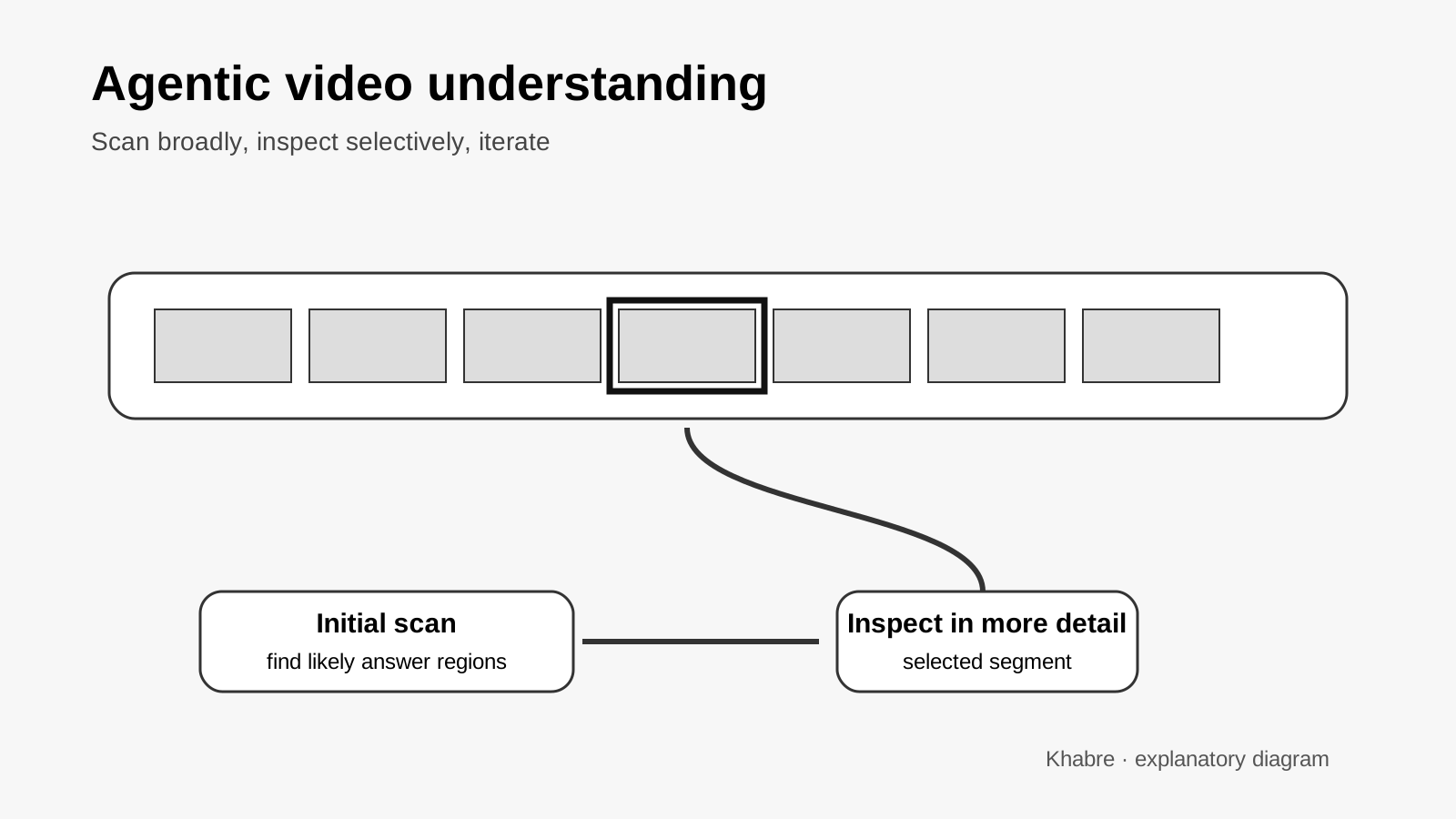
Instead of analysing a video through one fixed sampling strategy, the model can inspect an initial representation, identify which intervals are likely to contain the answer, return to those segments and gather more detail before responding.
Google says the feature is available for Gemini 3.7 Flash, Gemini 3.6 Flash and Gemini 3.5 Flash-Lite.
Contents
- What agentic video understanding means
- Why long videos are difficult for AI
- How the new approach works
- Google's reported efficiency gains
- Where it could be useful
- What still needs independent validation
What agentic video understanding means
In this context, “agentic” does not mean the model acts independently without constraints. It means the model can make intermediate decisions about how to inspect the video.
A conventional pipeline may sample frames at a fixed rate, transcribe audio and then send the resulting representation to a model. That is predictable, but it can waste computation on irrelevant sections while missing detail in a short but important interval.
The agentic approach lets Gemini use an iterative search process. It can first scan broadly, then revisit selected portions at finer granularity.
Why long videos are difficult for AI
Video contains far more information than a still image. A minute of footage may contain thousands of frames, spoken language, environmental sounds, on-screen text and events that unfold over time.
Sending all of that information to a model at full detail is expensive in both tokens and compute. Reducing the sampling rate lowers cost but risks missing brief events.
The core engineering problem is therefore selective attention: determining which parts deserve closer inspection without already knowing the answer.
How the new approach works
Google describes a multi-step process in which Gemini can dynamically scan segments, inspect transcripts or audio, and request additional detail where needed.
For a question such as “When does the person replace the battery?”, the system may first find candidate intervals where the device is opened, then inspect those intervals more closely instead of processing the entire recording at maximum detail.
That makes the workflow closer to how a human searches a long recording: skim first, then inspect the likely answer location.
Google's reported efficiency gains
Google reports reductions of up to 88% in token consumption and up to 66% in analysis cost, with quality improvements of up to 7% in its evaluations.
Those figures are vendor-reported benchmark results and should not be interpreted as guaranteed savings for every workload. Actual gains will depend on video length, question type, model selection and how much of the video requires detailed inspection.
The feature can be enabled through Google AI Studio and the Gemini Enterprise Agent Platform using the agentic configuration described by Google.
Where it could be useful
The approach is particularly relevant to long recordings in which only a small fraction contains the needed information.
Examples include security footage, sports analysis, instructional videos, meetings, industrial inspection video and research recordings.
It may also make multi-step video queries more practical. A model could locate an event, compare it with an earlier event and then answer a question using evidence from several points in the timeline.
What still needs independent validation
The reported cost and quality improvements come from Google. Independent testing will be needed to establish how reliably the system finds short or ambiguous events, how it performs on noisy audio, and whether selective inspection creates new failure modes when the initial scan overlooks something important.
The design nevertheless addresses a real limitation of multimodal AI: long video can be too information-dense to process naively.
If the model can learn when to look more closely, video understanding becomes less like reading every frame and more like conducting a targeted search.
Primary source
- Google DeepMind. Introducing agentic video understanding with Gemini. 1 September 2026. https://blog.google/innovation-and-ai/models-and-research/gemini-models/introducing-agentic-video-in-gemini/