Google has released Lyria 3.5, its latest music-generation model, in the Gemini app and Gemini API.
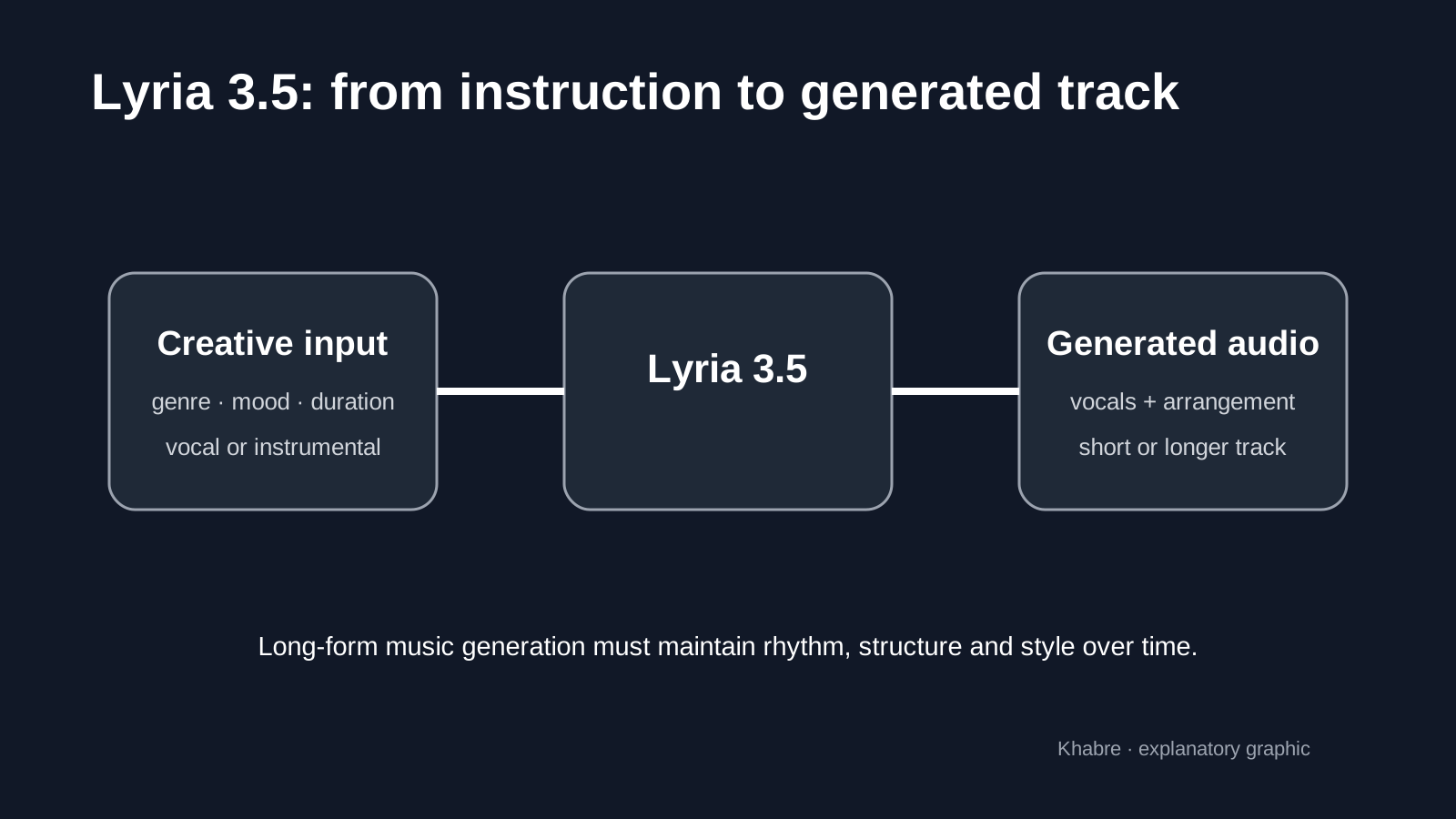
Announced on 4 September 2026, the new version is aimed at producing higher-fidelity tracks with more expressive vocals and richer musical arrangements. Google is also making it easier for users to specify genre, choose vocal or instrumental output and select between shorter and longer tracks.
Contents
- What Lyria 3.5 does
- What changed in this release
- Where it is available
- Why music generation is technically difficult
- What users should keep in mind
What Lyria 3.5 does
Lyria is Google's generative model family for music. A user describes the desired music in natural language or chooses a template, and the model generates an audio track matching the requested style and structure.
This differs from a conventional music library, where the software retrieves an existing recording. A generative model synthesizes a new output from patterns learned during training.
Google says Lyria 3.5 can generate both vocal and instrumental tracks and supports use cases such as background music, jingles, ringtones and creative experimentation.
What changed in this release
Google highlights three main improvements: more expressive vocals, richer musical arrangements and higher-fidelity output.
The Gemini interface now also provides clearer controls over genre and whether the user wants vocals or an instrumental track. Templates are intended to help users start from common use cases without having to design a detailed prompt from scratch.
Users can also choose between shorter and longer tracks, which makes the system more practical for different media formats.
Where it is available
Google says Lyria 3.5 is available globally in the Gemini app on web and mobile.
It is also available to developers through the Gemini API and Google AI Studio, and Google says it is being integrated into Flow Music and Google Vids.
That means the same underlying model can be used either interactively by an individual user or programmatically inside another application.
Why music generation is technically difficult
Music is not only a sequence of sounds. A convincing track has to maintain rhythm, harmony, instrumentation, structure and often vocal consistency over time.
Small errors can accumulate. A model may begin with a coherent chord progression but lose rhythmic or structural consistency as the track continues.
Longer generation therefore requires more than producing locally plausible audio. The system must maintain relationships across sections of the song while also preserving the requested style.
Vocals add another layer because the model must coordinate pitch, timing, phonetic content and musical expression.
What users should keep in mind
Google describes Lyria 3.5 as its best-sounding music-generation model, but that is a vendor claim, not an independent comparative finding.
AI-generated music also raises questions about provenance, copyright and disclosure. The legal treatment of generated music can vary by jurisdiction and by how much human creative input was involved.
For publishers and commercial users, generated audio should therefore be treated as a new asset with its own rights and disclosure considerations rather than automatically assumed to be equivalent to traditionally licensed music.
Primary source
- Google. Create your best tracks yet with Lyria 3.5 in Gemini. 4 September 2026. https://blog.google/innovation-and-ai/products/gemini-app/better-tracks-lyria-gemini/