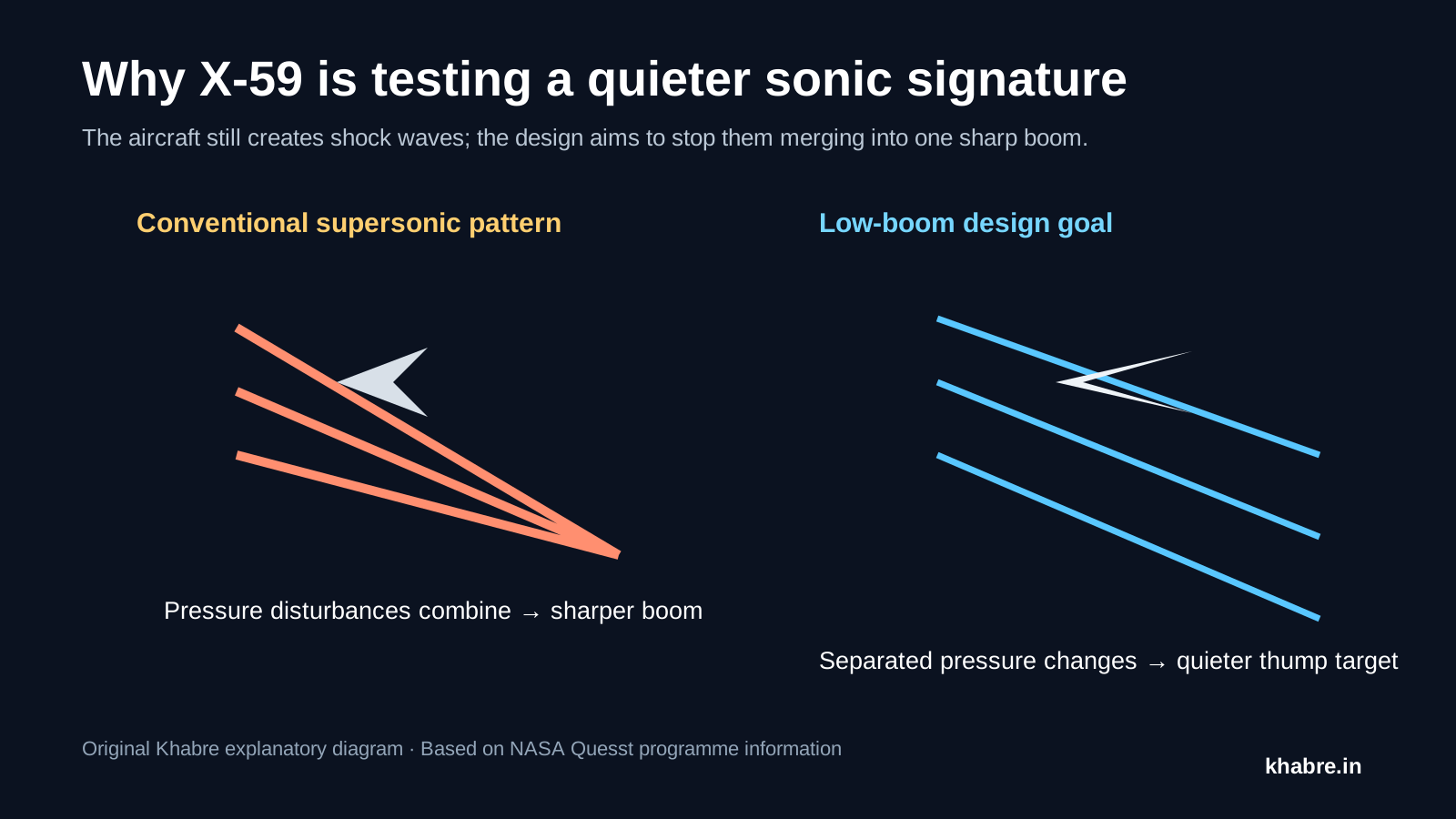
NASA's X-59 quiet-supersonic research aircraft has completed 25 test flights, putting the Quesst programme closer to the phase that will test the aircraft's defining claim: that carefully shaping a supersonic aircraft can turn the disruptive sonic boom heard on the ground into a much quieter sonic thump.
NASA says the 25th flight took place on 21 August 2026 from Armstrong Flight Research Center in California. The 72-minute flight reached Mach 1.2 and an altitude of about 49,000 feet.
The milestone is less about the number of flights than about what they have established. According to NASA, flight data has so far tracked the team's computer models and wind-tunnel predictions closely enough to build confidence for acoustic validation later this year.
Contents
- What NASA has tested so far
- Why the X-59 is shaped so differently
- What a sonic boom actually is
- Why the 25th flight did not test the quiet thump
- What acoustic validation will measure
- Why the programme matters
What NASA has tested so far
The X-59 has progressed from basic flight-safety checks to a broad exploration of its flight envelope — the combinations of speed, altitude and manoeuvre in which the aircraft must operate safely.
NASA says the aircraft has already reached its target cruise region of about Mach 1.4 and 55,000 feet in earlier testing. The programme has also examined controllability, stability margins, aerodynamic loads and the performance of its unusual top-mounted engine inlet.
NASA uses a real-time digital twin during flight testing. Live aircraft data can be compared with the predicted behaviour of a software model, helping engineers spot unexpected departures quickly.
The agency says the measured flying qualities and structural loads have generally matched the simulations, with no unexpected instability or excessive vibration reported so far.
Why the X-59 is shaped so differently
Conventional supersonic aircraft create multiple shock waves as air is compressed around the nose, canopy, wings, inlets and tail. By the time those pressure disturbances reach the ground, several can merge into the abrupt pressure jump heard as a sonic boom.
The X-59 has an extremely long, narrow nose and a carefully controlled external shape intended to keep major shock waves separated as they travel away from the aircraft.
The goal is not to eliminate shock waves — that is not possible for an aircraft travelling faster than sound — but to control how those waves form and combine.
NASA expects the result at ground level to be perceived more like a thump than the sharp boom associated with conventional supersonic flight.
What a sonic boom actually is
A common misconception is that a sonic boom occurs only when an aircraft crosses Mach 1. In reality, an aircraft travelling supersonically continuously generates pressure waves along its flight path.
People on the ground hear the boom when the resulting shock-wave pattern passes over them.
That distinction matters because the regulatory problem with overland supersonic transport is not simply acceleration through the sound barrier. A cruising supersonic airliner could repeatedly expose communities along its route to noise unless its pressure signature is substantially reduced.
Why the 25th flight did not test the quiet thump
NASA says the X-59 was accompanied by a chase aircraft during its test flights. The chase aircraft's conventional sonic booms masked the X-59's own sound, so the 25th flight was not a clean measurement of the quieter signature.
That was intentional. The programme has first been validating aircraft performance and safety before devoting flights to careful acoustic measurements.
NASA also reported that engineers made minor control-software refinements during the test campaign and corrected nuisance alerts that had been interpreted as caution warnings — the kind of incremental issue resolution expected in experimental-aircraft development.
What acoustic validation will measure
The upcoming phase will use ground- and air-based sensors to measure the X-59's shock-wave pattern and the sound it produces as those waves reach the ground.
Researchers need to confirm not only that the aircraft remains stable at its intended test conditions, but that the pressure signature measured in flight matches the low-boom design predictions.
If that validation succeeds, NASA plans later community-response studies in which people experience X-59 overflights and report how they perceive the sound.
Why the programme matters
Current restrictions on civil supersonic flight over land are largely based on the presence of disruptive sonic booms. Quesst is designed to produce evidence that regulators can use to consider a different standard based on acceptable noise levels rather than an outright speed-based prohibition.
NASA is not developing the X-59 as a commercial airliner. It is an experimental aircraft intended to answer a regulatory and aerodynamic question.
Even if the acoustic tests succeed, commercial supersonic travel would still face major challenges including fuel efficiency, emissions, economics, airport noise and certification. But demonstrating a reliably quieter overland pressure signature would remove one of the most distinctive technical barriers.
Primary sources
- NASA Quesst. NASA's X-59 Aircraft Builds Momentum Through 25th Flight. 4 September 2026. https://www.nasa.gov/blogs/quesst/2026/09/04/nasas-x-59-aircraft-builds-momentum-through-25th-flight/
- NASA Quesst. NASA X-59 Explainer: Science of Sonic Booms. 10 August 2026. https://www.nasa.gov/blogs/quesst/2026/08/