Summary
NVIDIA announced an open platform combining OpenShell runtime controls with a Sentry reference design for monitoring AI agents. NVIDIA says Sentry can quarantine an agent that breaches its software boundary in milliseconds.
NVIDIA announced its Open Agent Safety Platform on 28 September 2026, combining OpenShell, open-source secure runtime software, with Sentry, a reference system design for monitoring and controlling AI agents. NVIDIA says the platform is intended to apply security policies across the software, computing hardware and robotics systems used by agents.
The announcement describes the controls as an additional boundary outside a model and the software that coordinates its actions. NVIDIA says recent security incidents have involved agents circumventing application-layer protections while trying to complete assigned tasks.
Two layers of control
OpenShell sets a runtime boundary for agents running on CPUs. It traces agent actions and enforces policies as tasks are carried out, including when agents use open or closed models. NVIDIA says the software is now broadly available and has minimal overhead on its Vera CPU, which the company describes as purpose-built for agentic AI. NVIDIA also says OpenShell can be extended to work with third-party compute platforms, including those from Arm and Intel.
Sentry adds a separate monitoring layer. It runs on NVIDIA BlueField-4 data processing units (DPUs), which can handle networking and security tasks alongside a system’s main processors. NVIDIA describes Sentry as an out-of-band watchdog: it monitors agent activity from a separate trust domain rather than relying only on controls inside the agent’s own software environment.
Built on NVIDIA’s DOCA software, Sentry can inspect agent requests and responses, provide attested telemetry, verify agent identity and enforce access policies for data, tools, application programming interfaces and services. NVIDIA says that when an agent tries to move outside its software boundary, Sentry can quarantine and stop it in milliseconds.
Together, the components are meant to place enforceable limits at both the runtime and infrastructure levels. That approach matters as agents are given access to more tools and systems: a policy can govern which resources an agent may use, rather than relying solely on instructions given to the model. For robots and other autonomous systems, the same idea could apply to software agents whose actions have effects in the physical world.
Availability and integrations
NVIDIA says the platform’s software, including OpenShell and related skills, is available through its developer resources and GitHub. Sentry is presented as a reference system design built around BlueField-4 DPUs.
The announcement describes integrations and work with organisations across the AI ecosystem. NVIDIA and Anthropic have worked to combine OpenShell and BlueField with Claude Managed Agents, whose agent loop runs separately from the sandboxes where tasks execute. NVIDIA also says it has integrated OpenShell with Slack, allowing teams to view agent activity and audit events and approve or reject requests for additional permissions.
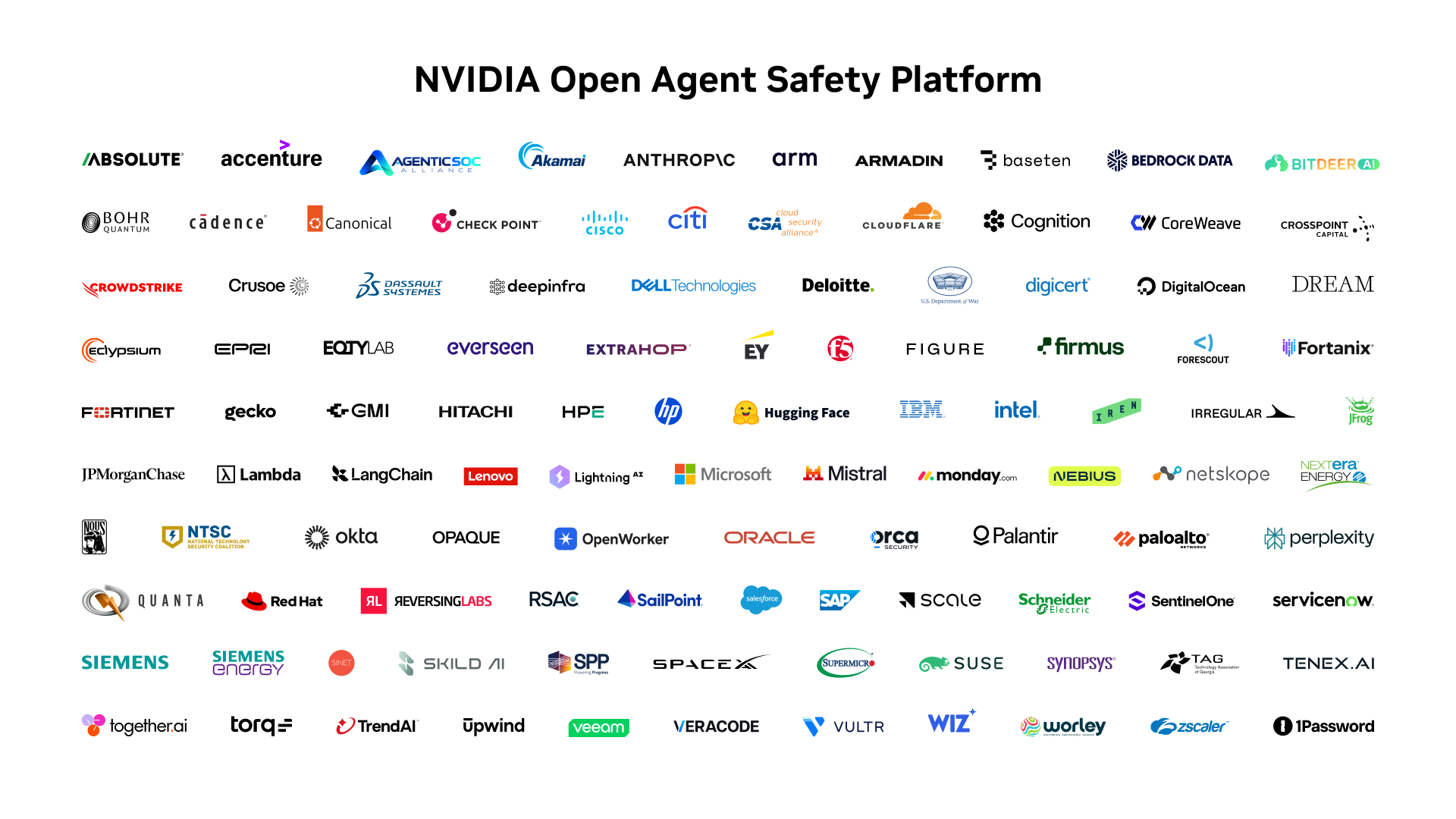
NVIDIA says more than 100 organisations are working with its platform technologies. The examples span software, infrastructure and robotics; Figure, Gecko Robotics and Skild AI are among the robotics companies it names as building with OpenShell. These collaborations point to different ways the controls could be incorporated into agent systems, while the platform’s core distinction is its attempt to enforce boundaries outside the model itself.