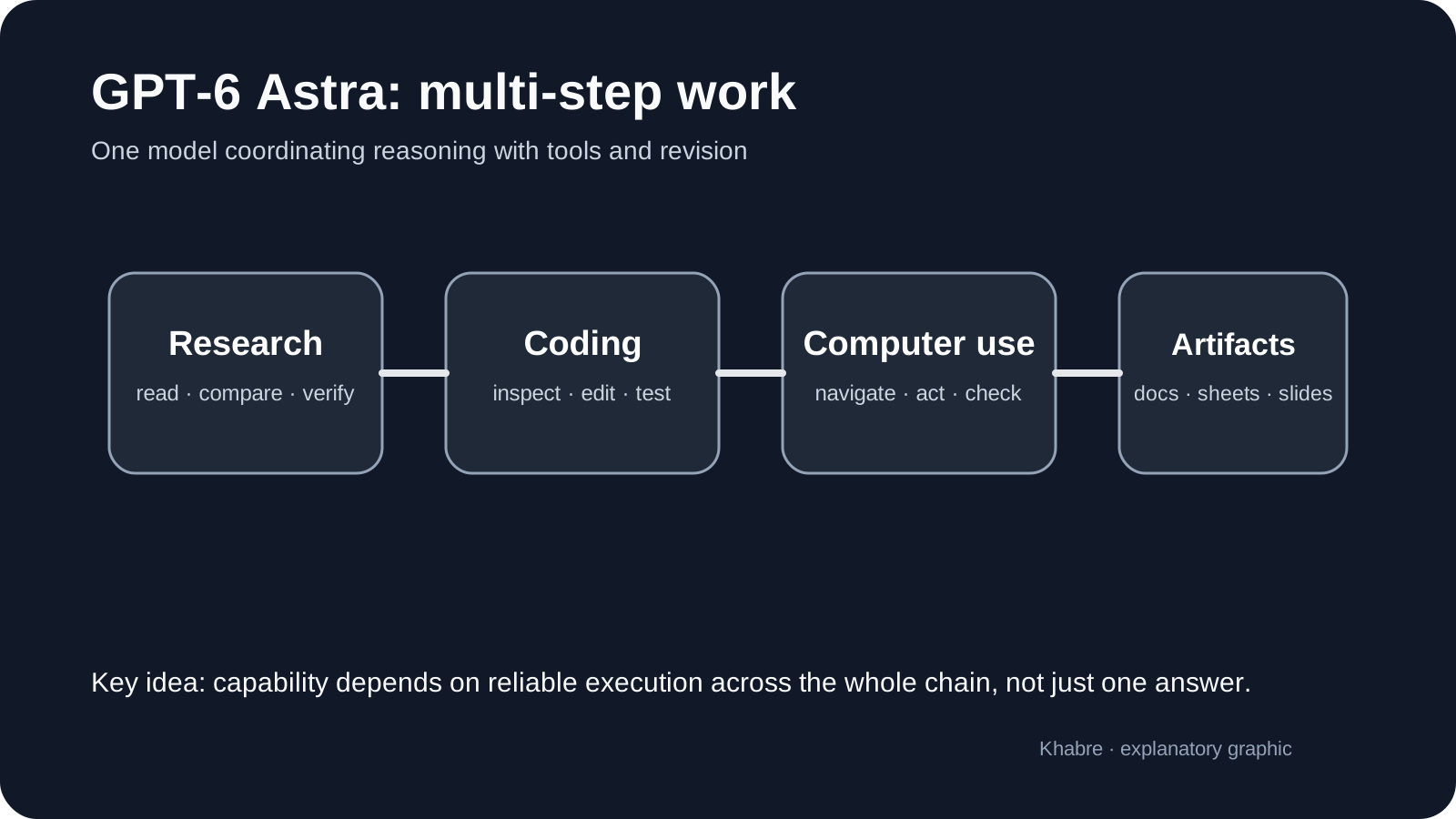
OpenAI has introduced GPT-6 Astra, a new model aimed at complex end-to-end work that combines reasoning with computer use, browsing, coding and professional document workflows.
OpenAI announced Astra on 3 September 2026 and is rolling it out in stages. The company says the model will become available through ChatGPT and the OpenAI API, with additional availability through Microsoft Azure and Amazon Bedrock.
The important change is not simply a higher benchmark score. Astra is designed to operate across a longer chain of work: reading information, deciding what to do next, using software tools, revising its own output and continuing until a task is complete.
Contents
- What GPT-6 Astra is
- Why computer use matters
- Coding and software engineering
- Research and scientific work
- Documents, spreadsheets and presentations
- Availability and API pricing
- How to interpret OpenAI's benchmark claims
What GPT-6 Astra is
A large language model normally predicts and generates text or other outputs in response to a prompt. An agentic model adds another layer: it can choose actions, use tools and evaluate intermediate results before deciding what to do next.
A useful analogy is the difference between answering a question about a spreadsheet and actually opening the spreadsheet, examining its structure, calculating values, correcting an error and returning a finished version.
OpenAI describes Astra as its most capable model for this type of multi-step work. The company specifically highlights computer use, browser use, software engineering, cybersecurity, science and professional tasks.
Why computer use matters
Many useful tasks cannot be completed with text generation alone. They require interaction with websites, desktop-style interfaces or business software.
A model with computer-use capability can, when given access and permission, inspect what is visible on a screen, identify controls, perform actions and then check whether those actions produced the expected result.
That creates new possibilities for automating administrative and knowledge-work tasks, but also raises a reliability problem: an error can become an action rather than remaining a wrong sentence. OpenAI says Astra includes additional monitoring intended to detect situations in which an agent may have misunderstood the user's instructions, allowing a task to be paused for review.
Coding and software engineering
OpenAI says Astra improves on previous models in software engineering and long multi-step coding tasks.
For software development, the practical challenge is often not writing a single function. A model may need to inspect an existing codebase, understand dependencies, change several related files, run tests, diagnose failures and iterate without damaging unrelated behavior.
That makes repository understanding and error recovery as important as code generation itself. OpenAI presents Astra as a model designed for these longer workflows rather than isolated code snippets.
Research and scientific work
OpenAI also positions Astra for research and scientific reasoning.
The company reports very high results on internal and external evaluations, including mathematical and scientific benchmarks. These results are useful indicators of model capability, but they should not be treated as proof that the model is correct on every scientific problem.
Scientific work still requires source verification, reproducible methods and domain expertise. A model can accelerate literature review, analysis or hypothesis generation, but it does not replace the evidentiary standards used in research.
Documents, spreadsheets and presentations
OpenAI says Astra can create and modify documents, spreadsheets and presentations while following templates and adapting when requirements change.
This is a significant product direction because office work usually involves repeated revision rather than a single prompt-and-response exchange. A model that can preserve formatting, incorporate feedback and continue across multiple stages is more useful than one that merely drafts text.
The same principle applies to data analysis: the value comes from being able to inspect the data, perform calculations, detect inconsistencies and revise the output, not merely describe what a spreadsheet could contain.
Availability and API pricing
OpenAI says Astra is initially rolling out to a limited set of organizations, with broader availability planned over the following days for ChatGPT Plus, Pro, Business and Enterprise users.
For developers, OpenAI lists the API model name as gpt-6-astra. The company announced standard API pricing of $10 per million input tokens and $50 per million output tokens.
Availability can change during a staged launch, so individual users may not see Astra immediately even if their plan is included in the rollout.
How to interpret OpenAI's benchmark claims
OpenAI reports state-of-the-art or near-saturating performance on several evaluations, including computer-use, software-engineering and reasoning benchmarks.
Those numbers should be read as vendor-reported evaluation results. Benchmark performance can be affected by task design, prompting, tool access and evaluation methodology, and it does not guarantee equivalent performance on every real-world workload.
The more important test for users is whether Astra can reliably complete multi-step work while preserving instructions, recovering from errors and producing outputs that can be independently checked.
Primary sources
- OpenAI. GPT-6 Astra: A new generation of intelligence. 3 September 2026. https://openai.com/index/gpt-6-astra/
- OpenAI. Release notes: Introducing GPT-6 Astra. 3 September 2026. https://openai.com/products/release-notes/