Qualcomm has expanded its Dragonwing family with two processors aimed not at flagship phones, but at the much larger world of embedded and edge-computing devices.
The Dragonwing Q-2390 targets commercial, enterprise and consumer systems, while the IQ-2390 is designed for industrial equipment requiring deterministic networking, real-time processing and long deployment lifecycles.
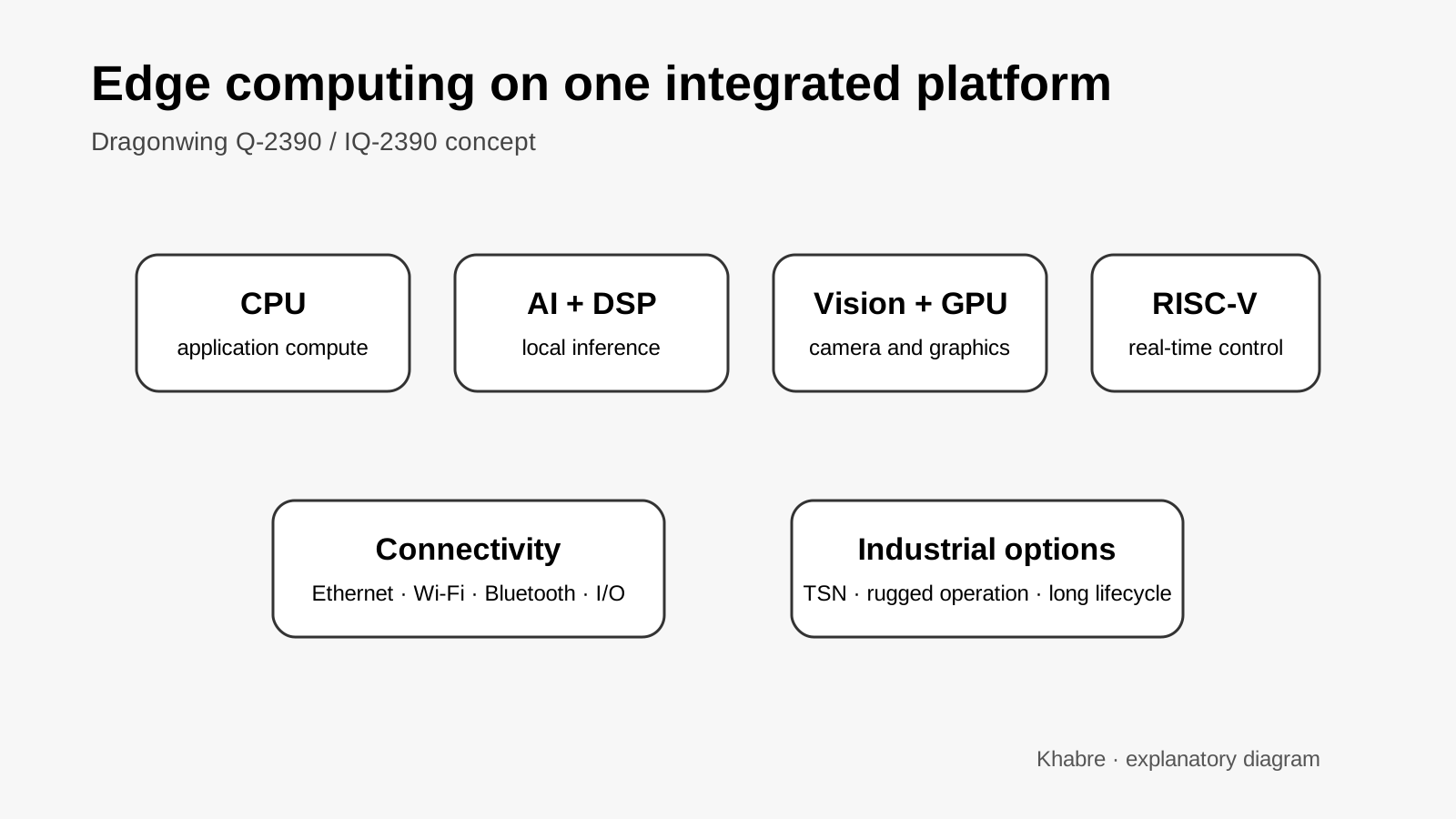
Both platforms combine general-purpose computing with dedicated AI, graphics, vision and microcontroller resources, reducing the number of separate chips that device makers may need to integrate.
Contents
- What the Q-2390 is designed for
- What makes the IQ-2390 different
- The common architecture
- Why the RISC-V microcontroller matters
- Edge AI beyond phones
- Availability
What the Q-2390 is designed for
Qualcomm positions the Q-2390 for compact systems where cost, power consumption and board space matter but where manufacturers still want local AI and computer-vision capability.
Potential applications listed by Qualcomm include retail terminals, kiosks, access-control systems, smart appliances, agricultural equipment, home robots, fitness equipment and enterprise devices.
The platform integrates application processing, on-device AI, camera and display support, wired and wireless connectivity options and extensive input/output interfaces.
That integration can simplify product design because a device may not need separate processors for application software, machine vision and low-level control.
What makes the IQ-2390 different
The IQ-2390 is aimed at industrial environments such as factory automation, machine vision, building management, utilities and energy systems.
It adds design priorities that matter more in industrial equipment than in ordinary consumer electronics: deterministic networking, extended temperature operation and long product lifecycles.
Qualcomm specifies dual Gigabit Ethernet with Time-Sensitive Networking, or TSN. TSN is a family of Ethernet standards designed to make network timing more predictable, which matters when machines must coordinate actions within tightly controlled time windows.
Qualcomm says the IQ-2390 is designed for an operating range from -30°C to +115°C and for environments exposed to vibration and shock.
The common architecture
Both processors use a heterogeneous design, meaning different kinds of compute engines handle different workloads.
Qualcomm lists a quad-core CPU configuration, an Adreno 704 GPU, Hexagon AI/DSP resources and a real-time RISC-V microcontroller.
The product pages specify CPU clocks of up to 1.9 GHz and AI performance of 1.1 TOPS for the Q-2390 and IQ-2390. TOPS is a theoretical measure of trillions of operations per second and should not be treated as a direct measure of application performance across different AI models.
The platforms support Android, Linux-based operating systems and Zephyr, giving manufacturers several software options depending on whether the product behaves more like a computer, an appliance or a real-time controller.
Why the RISC-V microcontroller matters
A microcontroller is useful for tasks that must respond predictably even while the main operating system is busy.
Examples include monitoring sensors, controlling motors or handling safety-related timing. Integrating a RISC-V microcontroller alongside the main CPU allows those real-time workloads to remain close to the rest of the system without requiring a completely separate controller in every design.
This is an example of a broader shift in embedded computing: one chip increasingly contains several different computing architectures optimized for different jobs.
Edge AI beyond phones
Much AI discussion focuses on cloud servers and smartphones, but many useful AI workloads occur closer to sensors and machines.
A camera in a production line may need to detect defects immediately. An access-control system may need to recognize an event without continuously uploading video. An energy controller may need to respond locally even when internet connectivity is unavailable.
Running more inference at the edge can reduce latency and bandwidth use and may improve privacy for some applications, although those benefits depend on how the complete product is designed.
Availability
Qualcomm says customer engagement is already underway through an early-access programme. Evaluation kits for both platforms are expected in early 2027.
That means the announcement describes platforms entering the design cycle rather than processors that consumers can immediately buy as standalone products.
Primary sources
- Qualcomm. Qualcomm Introduces Dragonwing Q-2390 and IQ-2390 Processors, Expanding Access to Intelligent Connected Devices. 1 September 2026. https://www.qualcomm.com/news/releases/2026/09/-qualcomm-introduces-dragonwing-q-2390-and-iq-2390-processors--e
- Qualcomm product pages for Dragonwing Q-2390 and IQ-2390.