Summary
NVIDIA says researchers used JUPITER, Europe’s first exascale supercomputer, to run a 104-qubit simulation of magic-state cultivation under realistic hardware noise. The work models a quantum processor; it is not a 104-qubit quantum machine.
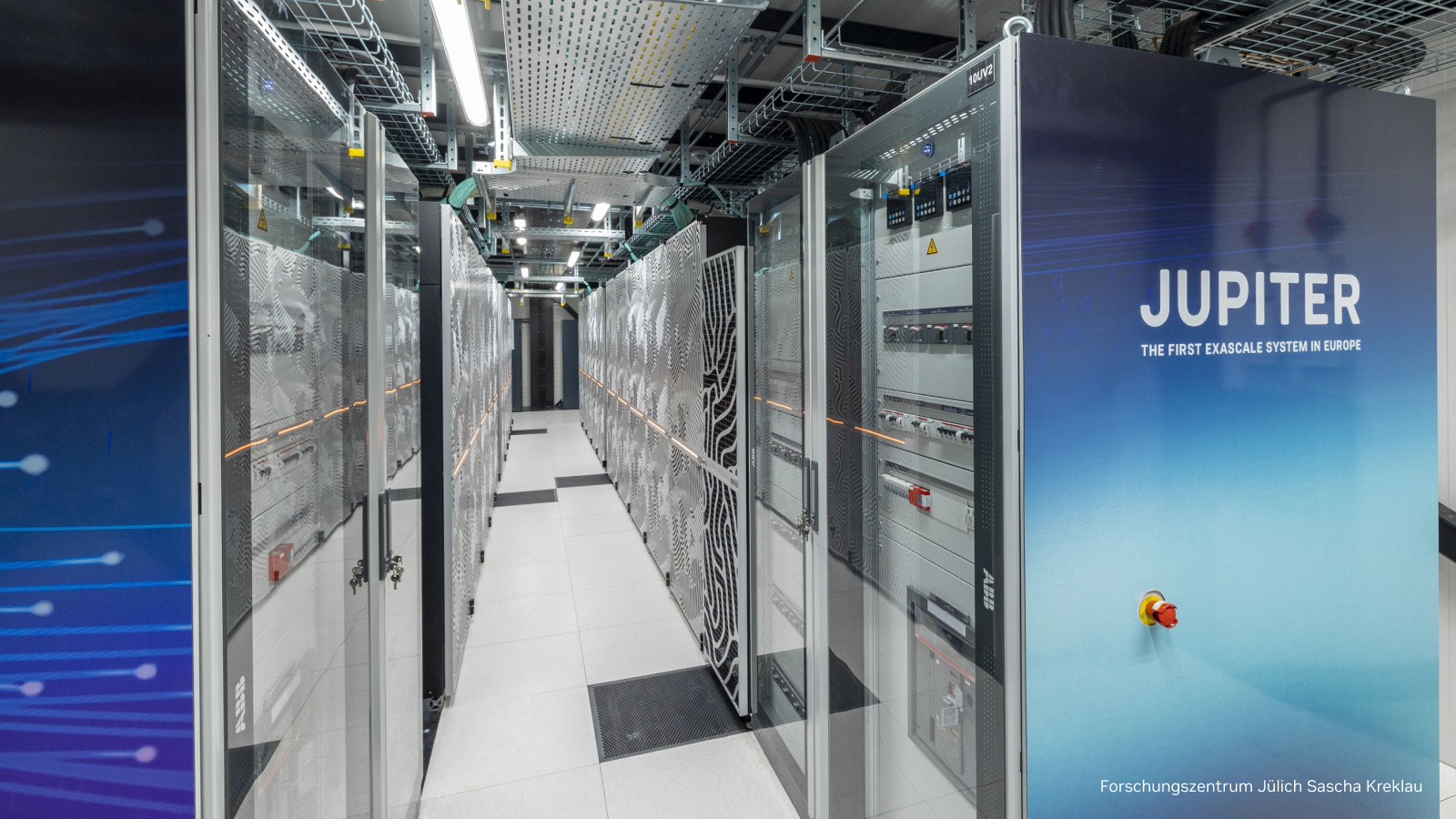
NVIDIA announced on October 19, 2026, that researchers had run a 104-qubit simulation of fault-tolerant quantum computing on JUPITER, the exascale supercomputer at Germany’s Jülich Supercomputing Centre. The company describes it as the largest comprehensive simulation of a fault-tolerant quantum processor to date. The computation ran on classical supercomputing hardware: the 104 qubits refer to the quantum system being modelled, not to qubits in a physical quantum computer.
The simulation focused on magic-state cultivation, a method for preparing a resource used repeatedly in fault-tolerant quantum computation. NVIDIA says the work modelled this process under realistic hardware noise, extending earlier Jülich simulations of 50 qubits that assumed noiseless conditions.
Why magic-state cultivation matters
Qubits are vulnerable to errors from noise. Fault-tolerant quantum computing aims to keep calculations reliable despite those errors. It uses logical qubits, which are built from physical qubits, along with error-correction techniques. Magic states are a particular resource consumed during fault-tolerant calculations, so producing them efficiently is an important part of reducing the resources a useful quantum computer may require.
NVIDIA says the simulation validated a state-of-the-art magic-state cultivation approach that uses 90% fewer physical qubits than previous methods. That figure is the company’s comparison of the approach with earlier methods. Simulating the process with noise can help researchers examine how errors affect a design before building quantum hardware, and evaluate possible improvements.
Scaling the simulation to JUPITER
The simulation’s memory demands grow rapidly with the number of qubits, making large-scale modelling difficult. NVIDIA says an NVIDIA GB200 NVL72 system at its Accelerated Quantum Research Center was used to develop and test the methods. Researchers scaled tests from four GPUs to hundreds before moving the work to 8,192 GPUs on JUPITER. The development work, according to NVIDIA, reduced a simulation effort that had taken weeks to days.
The project used NVIDIA cuQuantum software for simulation performance and scaling, and the fault-tolerant logical layer in the CUDA-Q platform to express the magic-state circuit. The large-scale run gives researchers a way to study a more detailed noisy model than the earlier noiseless work, which could inform choices about future quantum-system designs. It is a computational tool for studying quantum hardware, rather than a demonstration that a 104-qubit fault-tolerant quantum computer has been built.