A study in Nature Medicine has identified a possible role for oligodendrocytes — the cells that make myelin in the central nervous system — in explaining why some people experience greater cognitive decline with ageing than others.
Myelin is the insulating membrane wrapped around many nerve fibres. It helps electrical signals travel efficiently and also supports the metabolic health of axons.
What the researchers studied
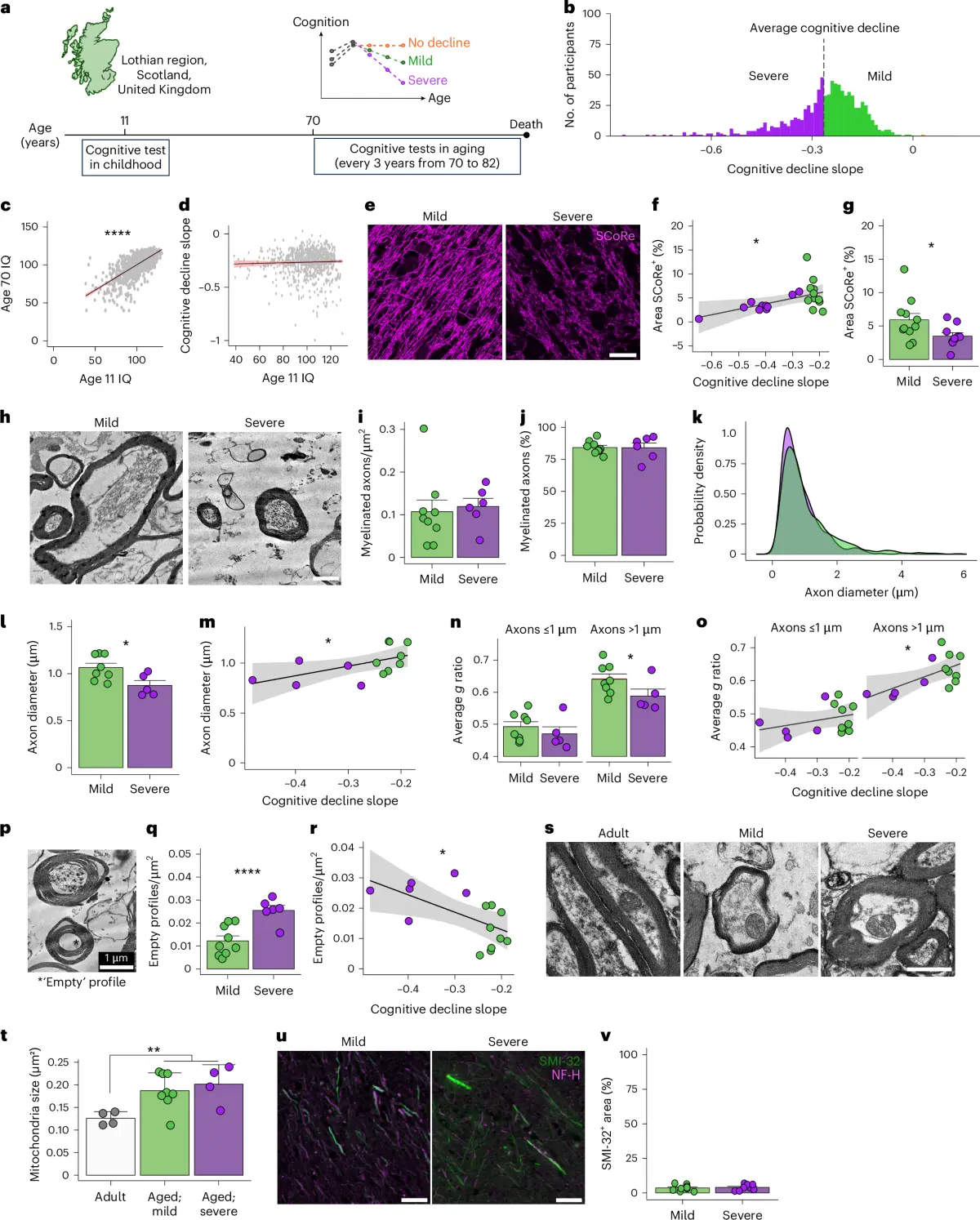
The investigators analysed human brain tissue linked to longitudinal cognitive data, allowing them to compare white-matter biology with how cognition had changed during life rather than relying only on a single cognitive measurement near death.
They examined structural and molecular features of oligodendrocytes and myelinated axons, and then used experimental models to test whether some of the observed changes could influence cognition.
What they found in human tissue
Worse cognitive trajectories were associated with several unexpected white-matter changes.
The researchers reported smaller myelinated axons, thicker myelin and increased numbers of oligodendrocytes. Those oligodendrocytes showed reduced activity of NRF2-related pathways.
NRF2 is a transcription factor involved in cellular responses to oxidative stress and maintenance of cellular resilience.
The finding is notable because more oligodendrocytes did not necessarily mean healthier white matter. The data instead suggest that the functional state of the cells and the quality of the myelin they produce may matter more than cell number alone.
Experimental evidence
To investigate whether reduced NRF2 activity could contribute rather than merely accompany ageing, the team created aged mice with oligodendrocyte-specific loss of NRF2.
Those animals showed white-matter changes resembling features seen in human cognitive decline and had less cognitive improvement over time in experimental testing.
That strengthens the mechanistic case, although animal modelling cannot establish that the same pathway is the dominant cause of cognitive decline in humans.
Why this matters
Age-related cognitive decline is often discussed almost entirely in terms of neurons. This work highlights the importance of the cells that support neuronal wiring.
Oligodendrocytes help maintain myelin throughout life. If their stress-response systems deteriorate with age, communication across distributed brain networks could become less efficient even without widespread neuronal death.
The study therefore adds white-matter biology to the list of processes that may shape cognitive ageing.
What this does not mean
The study does not show that activating NRF2 in people will prevent dementia or reverse cognitive decline.
It also does not establish a diagnostic test based on oligodendrocytes or myelin thickness. The human findings are associations supported by mechanistic animal work, not a clinical intervention trial.
The next step is to determine whether the pathway is reproducible across independent human cohorts and whether it can be modified safely in ways that preserve cognition.
Primary source
- Craig GA, et al. Oligodendrocyte dysfunction in human age-related cognitive decline. Nature Medicine. Published 25 August 2026. DOI: 10.1038/s41591-026-04608-y. https://www.nature.com/articles/s41591-026-04608-y