India's Aditya-L1 solar observatory has detected a pattern that could eventually help scientists understand how large solar flares build up before they erupt.
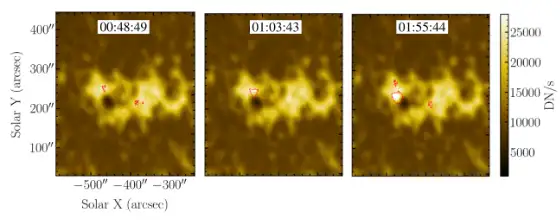
ISRO reported on 28 August that researchers using three Aditya-L1 instruments found small, short-lived brightenings in ultraviolet and X-ray observations during the hours preceding a major flare. The brightenings were concentrated around the same part of the Sun where the flare later occurred.
The result is not yet an operational flare-warning system. It is evidence that measurable changes can occur before a major eruption, and that those changes can be localized in the future flare region.
What was observed
The analysis combined simultaneous observations from three payloads aboard Aditya-L1, India's first dedicated solar observatory.
The researchers identified transient brightenings before a major solar flare. These events were comparatively small, but they appeared repeatedly in the hours leading up to the flare and were spatially clustered around the later eruption site.
That matters because the Sun is magnetically active long before a flare becomes obvious. A flare is the rapid release of stored magnetic energy in the solar atmosphere. The difficult forecasting problem is identifying which active regions are simply complex and which are approaching an eruption.
A recurring precursor signal could provide one additional piece of evidence.
Why solar flares matter on Earth
Large solar flares can produce intense electromagnetic radiation. Their effects can include disruption of high-frequency radio communication, interference with satellite navigation, increased radiation exposure for spacecraft and astronauts, and stress on satellite systems.
Forecasting therefore has practical value. Space-weather services already monitor active regions, magnetic complexity and other indicators. The Aditya-L1 result suggests that short-lived ultraviolet and X-ray brightenings may add another observable signature of the processes occurring shortly before eruption.
What this does not establish
A precursor seen in one analysis is not automatically a reliable forecasting rule.
A useful warning system would need to answer several harder questions: how often the same pattern appears before major flares, how often similar brightenings occur without a subsequent flare, whether the signal works across different classes of active region, and how early it can be detected with acceptable false-alarm rates.
Those validation questions matter because an observation can be scientifically real without yet being operationally predictive.
Why Aditya-L1 is useful for this problem
Aditya-L1 operates around the Sun-Earth L1 point, giving it a continuous view of the Sun without repeated Earth occultations associated with low-Earth-orbit spacecraft.
Its payload suite observes the solar atmosphere across multiple wavelengths. Different wavelengths sample different temperatures and physical layers, allowing researchers to compare changes in the lower and hotter parts of the solar atmosphere as magnetic energy accumulates and is released.
The new work used simultaneous ultraviolet and X-ray observations, which is particularly valuable because flare preparation is not a single-layer process.
What to watch next
The strongest next step is replication across a larger set of flares. If the same spatially localized brightenings recur before many major events, researchers can begin to measure sensitivity, specificity and lead time.
For now, the finding is best understood as a promising physical clue rather than a finished forecasting tool.
Primary source
- Indian Space Research Organisation. Aditya-L1 Catches the Sun's Early Warning Signs Before Solar Flares. 28 August 2026. https://www.isro.gov.in/Aditya_L1_Catches_the_Suns_Early_Warning_Signs.html