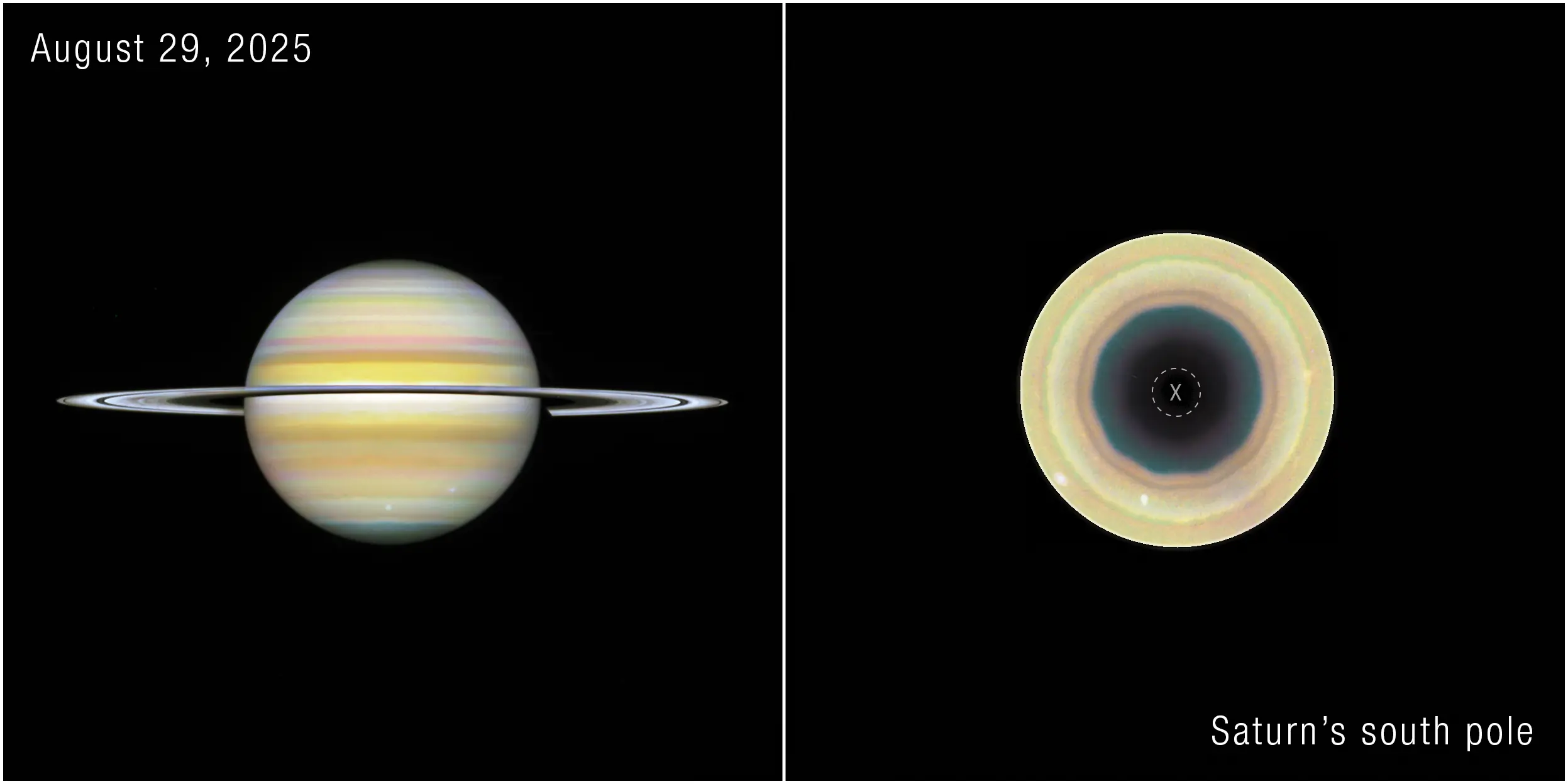
NASA's Hubble Space Telescope has tracked a large 10-sided atmospheric pattern encircling Saturn's south pole.
The feature is a decagon — a roughly polygonal wave with ten sides — and NASA describes it as evolving over time rather than being a rigid geometric structure.
Saturn is already famous for the persistent six-sided jet-stream pattern around its north pole. The new southern feature shows that large-scale polygonal waves are not unique to the northern hemisphere, although the two structures are not identical.
What Hubble observed
Hubble observations show a broad atmospheric wave circling the south polar region.
From a distance, planetary atmospheres can look smooth, but they contain jets, vortices, waves and cloud systems that interact over enormous distances. When strong zonal winds become unstable, they can organize into repeating wave patterns.
A polygon is therefore not a solid boundary. It is the visible expression of a wave moving through a rotating atmosphere.
Why polygons can form in atmospheres
Saturn rotates rapidly, completing a day in roughly ten and a half hours. Rapid rotation strongly influences atmospheric motion through the Coriolis effect.
When fast-moving jets interact with surrounding air, waves can develop along the jet. Under some conditions, those waves can settle into a repeating pattern that appears polygonal when viewed around a pole.
Laboratory experiments with rotating fluids have reproduced polygon-like structures, helping researchers understand how geometry can emerge from fluid dynamics without any physical wall or fixed surface feature.
How this differs from Saturn's northern hexagon
The north-polar hexagon has been observed for decades and is associated with a strong eastward jet.
The newly reported southern pattern has ten sides and appears to be evolving. That difference matters because the number of sides, size and persistence of a polygon depend on the speed and width of the jet, the surrounding wind field and how atmospheric waves interact.
Scientists can therefore use the geometry as a clue to the underlying circulation.
Why long-term observations matter
Outer-planet weather changes slowly by human standards in some respects and rapidly in others.
Saturn takes about 29 Earth years to orbit the Sun. Its seasons therefore last more than seven Earth years. Long-running observatories such as Hubble can watch atmospheric features across substantial fractions of a Saturnian season.
That continuity is valuable because a single image cannot tell researchers whether a structure is stable, forming, weakening or migrating.
What this does not mean
The decagon is not a permanent solid feature on Saturn, nor does it imply an artificial or unexplained geometric structure.
It is an atmospheric wave pattern produced by fluid dynamics in a rapidly rotating planet.
The interesting scientific questions concern why this particular wave has ten sides, how long it persists and how its behaviour changes with Saturn's seasonal circulation.
Why Saturn remains a useful atmospheric laboratory
Saturn has no solid surface beneath its visible clouds. Its atmosphere can therefore develop circulation systems on scales difficult to reproduce on Earth.
Comparing the northern hexagon, southern decagon, polar vortices and changing cloud bands gives researchers a natural laboratory for studying rotating fluids and planetary weather.
Those lessons are useful not only for Saturn but for understanding atmospheres on other giant planets and, more generally, how jets organize under rapid rotation.
What to watch next
Continued Hubble observations can show whether the decagon persists, changes its number of sides or weakens as Saturn's season evolves.
Measurements of wind speed and cloud motion will be especially useful for testing models of the wave and comparing it with the better-known northern hexagon.
Primary source
- NASA Science. NASA's Hubble Tracks New Decagon Encircling Saturn's South Pole. September 2026. https://science.nasa.gov/missions/hubble/nasas-hubble-tracks-new-decagon-encircling-saturns-south-pole/