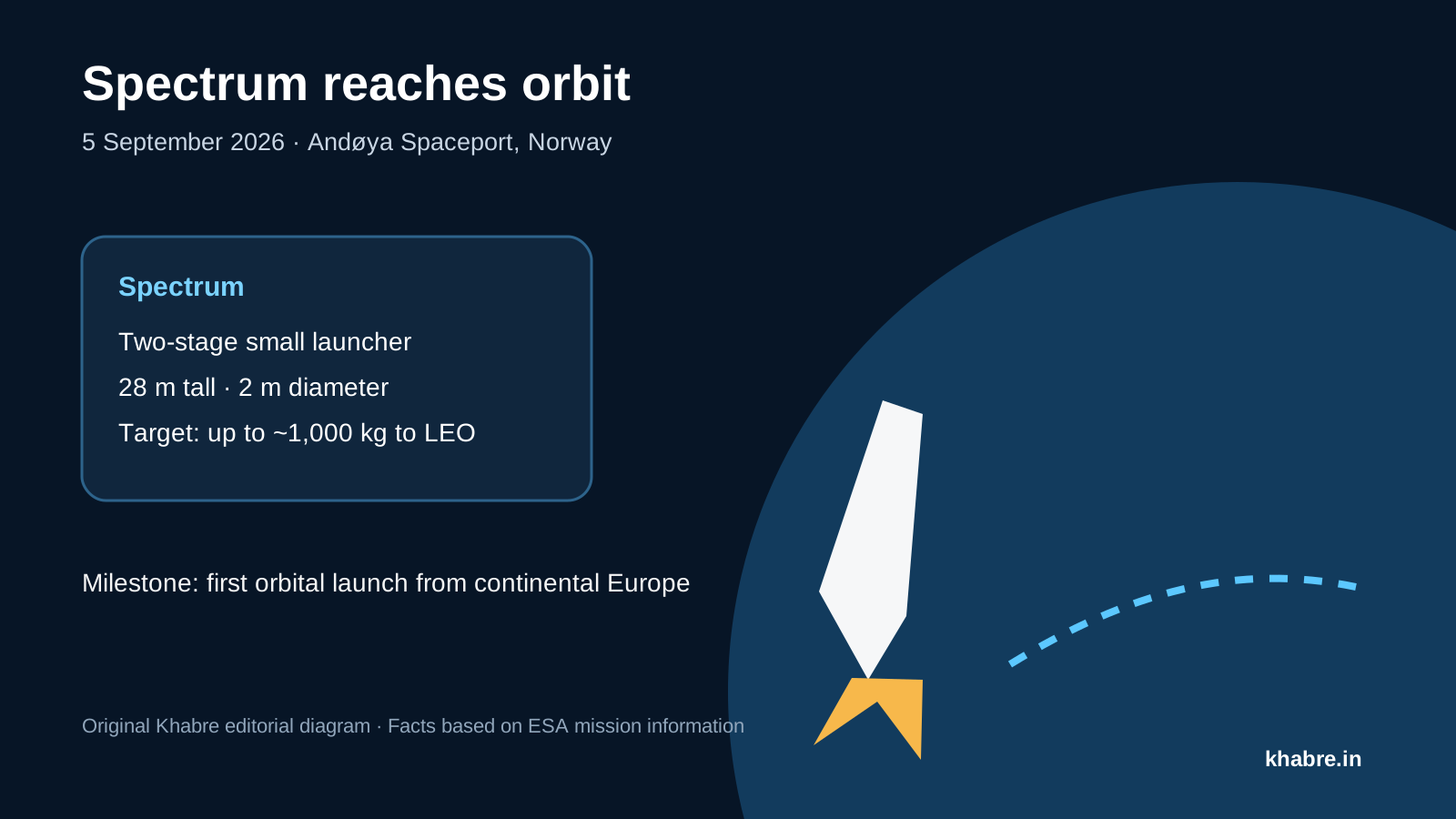
German launch company Isar Aerospace successfully placed payloads into low Earth orbit from Andøya Spaceport in Norway on 5 September 2026, according to the European Space Agency.
ESA described the mission as the first orbital launch achieved from continental Europe. Spectrum, Isar Aerospace's two-stage launch vehicle, lifted off at 22:12 CEST and delivered a group of commercial and educational payloads to orbit.
The flight is important not because Europe is new to orbital launch — Ariane and Vega missions have operated for years from Europe's Spaceport in French Guiana — but because it demonstrates an orbital launch system operating from the European mainland region and built by a newer commercial provider.
Contents
- What Spectrum launched
- Why the flight is a milestone
- What Spectrum is designed to do
- How ESA has supported the programme
- What this means for European launch
What Spectrum launched
ESA says the second Spectrum flight carried six commercial and educational CubeSats as well as an experiment intended to demonstrate new technologies in orbit.
The mission, called Onward and Upward, was supported through ESA's Boost! programme. Some payload selections also followed Isar Aerospace's earlier win in the German Space Agency at DLR's Microlauncher Competition.
Reaching orbit is a fundamentally different achievement from completing an atmospheric test flight. An orbital launcher must accelerate its payload mostly sideways to several kilometres per second while controlling guidance, staging, propulsion and structural loads with high precision.
Why the flight is a milestone
ESA identified Spectrum as the first provider in its European Launcher Challenge to reach orbit. The challenge is designed to broaden Europe's launch-service base and requires participating providers to demonstrate orbital capability by specified milestones.
Commercial competition matters because satellite operators increasingly want launch options matched to smaller payloads, flexible schedules and dedicated missions rather than always flying as secondary payloads on larger rockets.
This does not mean Spectrum immediately replaces Europe's established launch vehicles. Ariane 6 and Vega-C serve different payload classes and mission needs. Spectrum instead adds another potential layer to Europe's launch ecosystem.
What Spectrum is designed to do
ESA describes Spectrum as a two-stage rocket measuring about 28 metres in height and 2 metres in diameter. It uses ten engines and is intended to place payloads of up to roughly 1,000 kilograms into low Earth orbit, depending on mission requirements.
That places it in the small-launcher category. Small launchers trade some economies of scale for mission flexibility: a customer may be able to choose a more specific orbit or launch window rather than waiting for a rideshare opportunity on a much larger vehicle.
The business case depends on reliability, launch cadence and cost. A successful orbital flight demonstrates technical capability, but repeated missions are needed before a launch system can establish an operational record.
How ESA has supported the programme
Isar Aerospace was initially supported through ESA's Business Incubation Centre network and later received co-funding through ESA's Boost! programme, which supports commercial space transportation services.
ESA has also selected Isar Aerospace within the European Launcher Challenge, an initiative intended to help establish multiple European launch providers.
That model is notable because it combines public-sector support with privately developed launch systems rather than relying exclusively on traditional agency-led launcher programmes.
What this means for European launch
Europe has spent the past several years rebuilding launch capacity after interruptions and transitions in its launcher fleet. A successful commercial orbital launch from Norway adds geographic and industrial diversity.
Andøya's northern latitude is particularly useful for missions targeting polar and Sun-synchronous orbits, which are widely used by Earth-observation satellites.
The longer-term significance will depend on whether Spectrum can repeat the achievement, increase launch frequency and win enough commercial missions to sustain operations.
For now, the 5 September flight is a clear technical milestone: a privately developed European small launcher has reached orbit from a continental European spaceport.
Primary sources
- European Space Agency. Isar Aerospace achieves first launch to orbit from continental Europe. 5 September 2026. https://www.esa.int/Enabling_Support/Space_Transportation/Boost/Isar_Aerospace_achieves_first_launch_to_orbit_from_continental_Europe
- European Space Agency. Spectrum liftoff to orbit. 5 September 2026. https://www.esa.int/ESA_Multimedia/Images/2026/09/Spectrum_liftoff_to_orbit