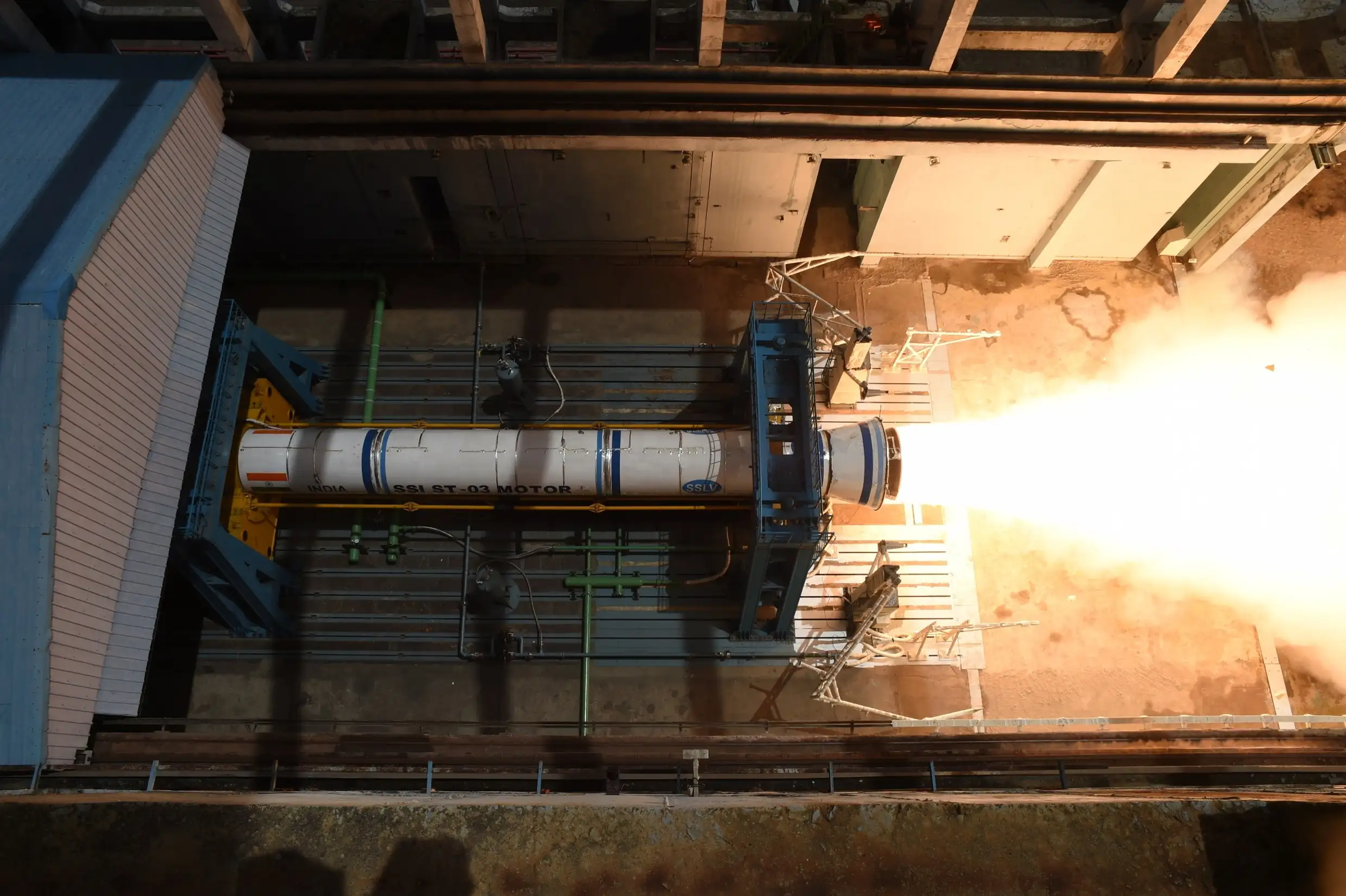
ISRO has completed a static ground test of an improved first-stage solid motor for the Small Satellite Launch Vehicle, or SSLV, and says the changes are expected to increase the rocket's low-Earth-orbit payload capability by about 100 kilograms.
The test took place on 11 August at the Satish Dhawan Space Centre in Sriharikota. ISRO reported the result the following day.
The significance is not simply a larger number on a payload chart. The design changes target both performance and manufacturability, which matters for a launcher intended to support quick-turnaround, launch-on-demand missions.
What changed
The improved SS1 first stage includes a higher propellant burn rate in two motor segments, an optimized thermal-protection system, process changes in the nozzle subsystem and a reduction in mass.
A solid rocket motor carries fuel and oxidizer together in a solid propellant grain. Once ignited, the burn profile is largely determined by the propellant formulation, grain geometry, motor pressure and nozzle characteristics.
Small changes in burn behaviour or structural mass can therefore alter the energy available to accelerate the upper stages and payload.
ISRO says the improved design is also intended to be more production-friendly, an important consideration if SSLV is to move toward larger-scale industrial manufacture.
What the test measured
The static test instrumented more than 600 parameters covering ignition, internal ballistics, structural behaviour, thermal performance, dynamics and acoustics.
A static firing is performed with the motor firmly restrained on the ground. It cannot reproduce every condition of flight, but it allows engineers to measure thrust behaviour, pressure, temperatures, structural loads and vibrations in a controlled setting.
ISRO says the observed motor performance was close to predicted performance and that the test qualified the design improvements implemented in SS1.
Why 100 kilograms matters
Launch-vehicle payload gains are often difficult because rockets must accelerate not only the payload but every kilogram of their own structure and propellant.
Removing inert mass from a lower stage can have a compounding benefit because that mass would otherwise have to be accelerated for part of the ascent. Improving propulsion performance can similarly leave more energy available for the payload.
ISRO estimates that the improved SS1 could raise SSLV payload capability to low Earth orbit by about 100 kilograms once introduced.
The exact benefit for a real mission would still depend on target orbit, inclination and mission profile.
Where SSLV fits
SSLV was designed as a comparatively small, production-oriented launch vehicle with short turnaround and launch-on-demand capability.
It uses three solid stages followed by a velocity-trimming module. ISRO has previously tested an improved third stage using a carbon-epoxy motor case, which the agency said could add roughly 90 kilograms of payload capability.
The first-stage change therefore forms part of a broader effort to reduce inert mass and improve the production characteristics of the vehicle.
What this does not mean
The ground test does not itself demonstrate the full payload improvement in flight.
The 100-kilogram figure is ISRO's estimated enhancement after induction of the improved stage. A complete launch vehicle must still integrate the new configuration, and actual mission performance will ultimately be demonstrated through flight.
Likewise, a successful motor test does not imply that all production, integration or operational challenges are solved.
Why manufacturability is part of the story
SSLV was conceived not only as a technical vehicle but as one that could be built more easily by industry and launched with relatively short preparation times.
ISRO says technology transfer to Indian industry is already under way. In that context, nozzle process simplification and a production-friendly design can be almost as important as raw performance gains.
A launch system becomes commercially useful when it can be manufactured consistently, integrated efficiently and flown repeatedly — not simply when its propulsion works once.
Primary source
- Indian Space Research Organisation. ISRO tests an improved version of the first stage of Small Satellite Launch Vehicle (SSLV). 12 August 2026. https://www.isro.gov.in/first_stage_of_Small_Satellite_Launch_vehicle.html