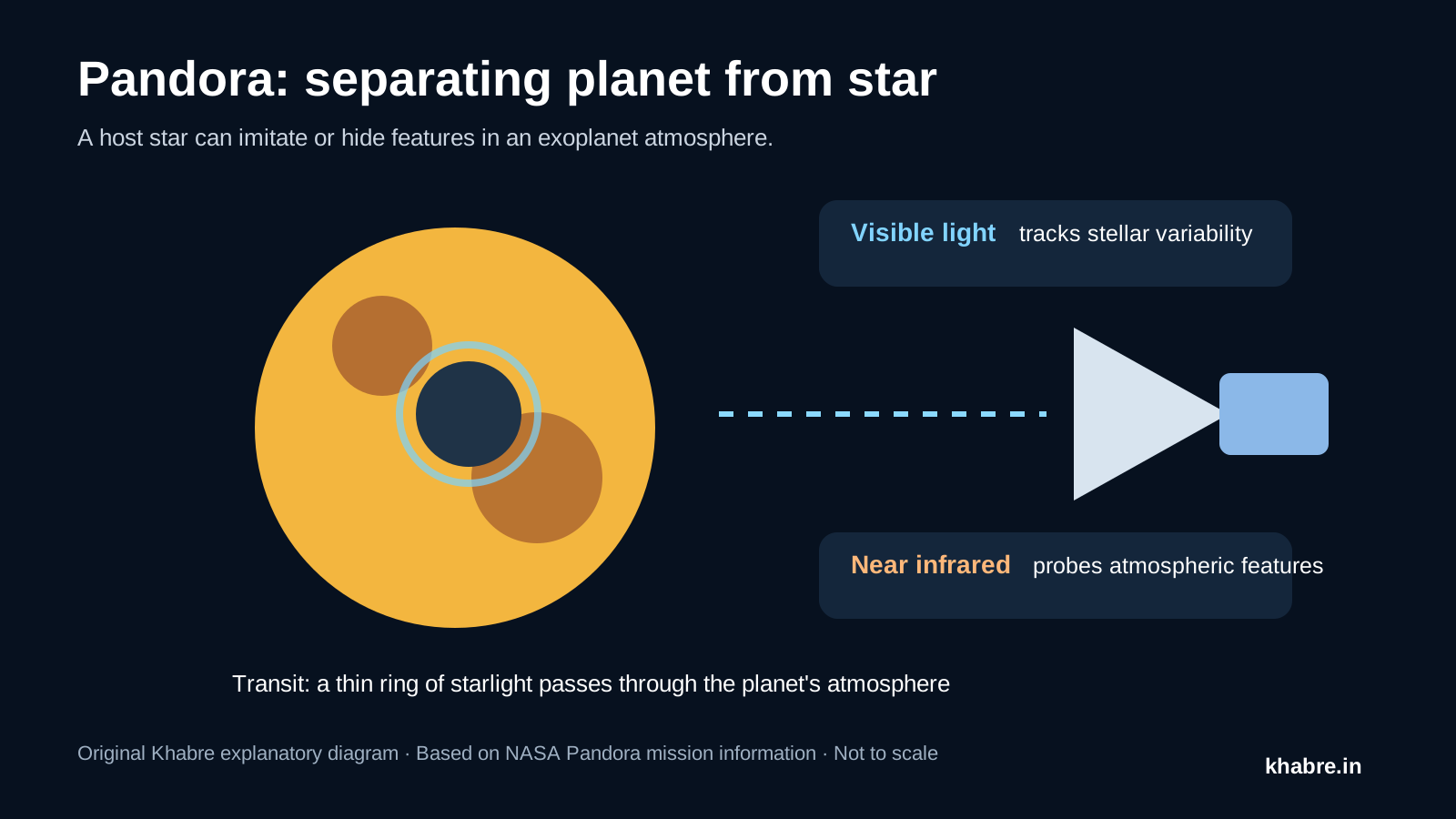
NASA's Pandora mission has begun science observations of exoplanets and their host stars, using a small space telescope to tackle a problem that can complicate measurements made by much larger observatories: the star itself can mimic or hide features in a planet's atmosphere.
NASA announced on 25 August 2026 that Pandora is now making its planned observations. The mission is designed to study at least 20 known exoplanets and determine how much of the signal measured during a transit comes from the planet and how much comes from bright and dark structures on the star.
Pandora is the first satellite launched through NASA's Astrophysics Pioneers programme, which is intended to pursue focused astrophysics questions with relatively small missions.
Contents
- Why exoplanet atmospheres are difficult to measure
- What Pandora measures
- How a transit reveals an atmosphere
- Why starspots can mislead astronomers
- Why Pandora watches for so long
- How Pandora complements Webb
Why exoplanet atmospheres are difficult to measure
When an exoplanet passes in front of its star as viewed from Earth, the planet blocks a small fraction of the star's light. If the planet has an atmosphere, an even smaller fraction of the starlight passes through that atmosphere before reaching a telescope.
Atoms and molecules absorb specific wavelengths. Astronomers therefore compare the spectrum measured during transit with the star's normal spectrum to look for chemical signatures associated with the planet's atmosphere.
The difficulty is that stars are not uniform light bulbs. Their surfaces contain cooler dark regions, hotter bright regions and magnetic activity that change over time.
Those structures can alter the measured spectrum by amounts comparable to the faint atmospheric signal astronomers are trying to isolate.
What Pandora measures
Pandora observes each target star simultaneously in visible and near-infrared wavelengths.
Visible-light measurements help the mission track how bright and dark areas are distributed across the stellar surface. Infrared observations cover wavelengths that are useful for studying the transiting planet's atmosphere.
By monitoring both at the same time, scientists can build a better model of the star and subtract its changing contribution from the combined signal.
NASA says Pandora will investigate the atmospheric composition of at least 20 exoplanets, including the presence of hazes, clouds and water.
How a transit reveals an atmosphere
A transit can be thought of as a natural backlight experiment.
Most of the star is unobstructed, but a thin ring of starlight passes through the planet's atmosphere. Molecules in that atmosphere absorb selected wavelengths before the light reaches the telescope.
If a molecule such as water vapour absorbs strongly at a particular wavelength, the planet can appear microscopically larger at that wavelength because the atmosphere blocks more light there.
The effect is small. Extracting it requires precise measurements over repeated transits and careful correction for instrumental and stellar effects.
Why starspots can mislead astronomers
Imagine that an exoplanet crosses a relatively quiet part of a star while another portion of the visible stellar surface is covered by cool starspots.
The star's overall spectrum is then different from the spectrum of the specific region behind the planet. An analysis that assumes a perfectly uniform stellar surface can assign some of that difference to the planet's atmosphere.
The opposite can happen with bright active regions. Stellar contamination can therefore either exaggerate or suppress apparent atmospheric features.
This issue is especially important for active stars and for planets whose atmospheric signals are weak.
Why Pandora watches for so long
NASA's observing plan calls for each target system to be observed repeatedly, with long sessions that cover the star before, during and after planetary transits.
Those extended observations help scientists track how the stellar surface changes and establish a baseline for the transit measurement.
Pandora's small size is an advantage for this particular task because it can dedicate long blocks of observing time to a modest set of targets. Very large observatories such as the James Webb Space Telescope have many competing science programmes and cannot easily spend the same amount of time monitoring every host star.
How Pandora complements Webb
Pandora is not designed to outperform Webb in sensitivity. Its role is complementary.
Webb can obtain extremely detailed spectra of selected exoplanet atmospheres. Pandora can provide the stellar context needed to interpret some of those spectra more reliably.
NASA specifically designed the mission to investigate whether apparent atmospheric signals are being altered by the host star. Better stellar models can therefore improve the interpretation of data collected by Webb and other observatories.
Pandora's science data will be publicly available through the NASA Exoplanet Archive. That should allow researchers outside the mission team to compare its stellar measurements with observations from other telescopes.
The mission's larger value is methodological: as astronomers try to identify ever subtler atmospheric features, understanding the star becomes part of understanding the planet.
Primary sources
- NASA Science. NASA's Pandora Mission Begins Study of Exoplanets, Host Stars. 25 August 2026. https://science.nasa.gov/missions/pandora-missions/nasas-pandora-mission-begins-study-of-exoplanets-host-stars/
- NASA Science. Pandora mission overview. https://science.nasa.gov/mission/pandora/