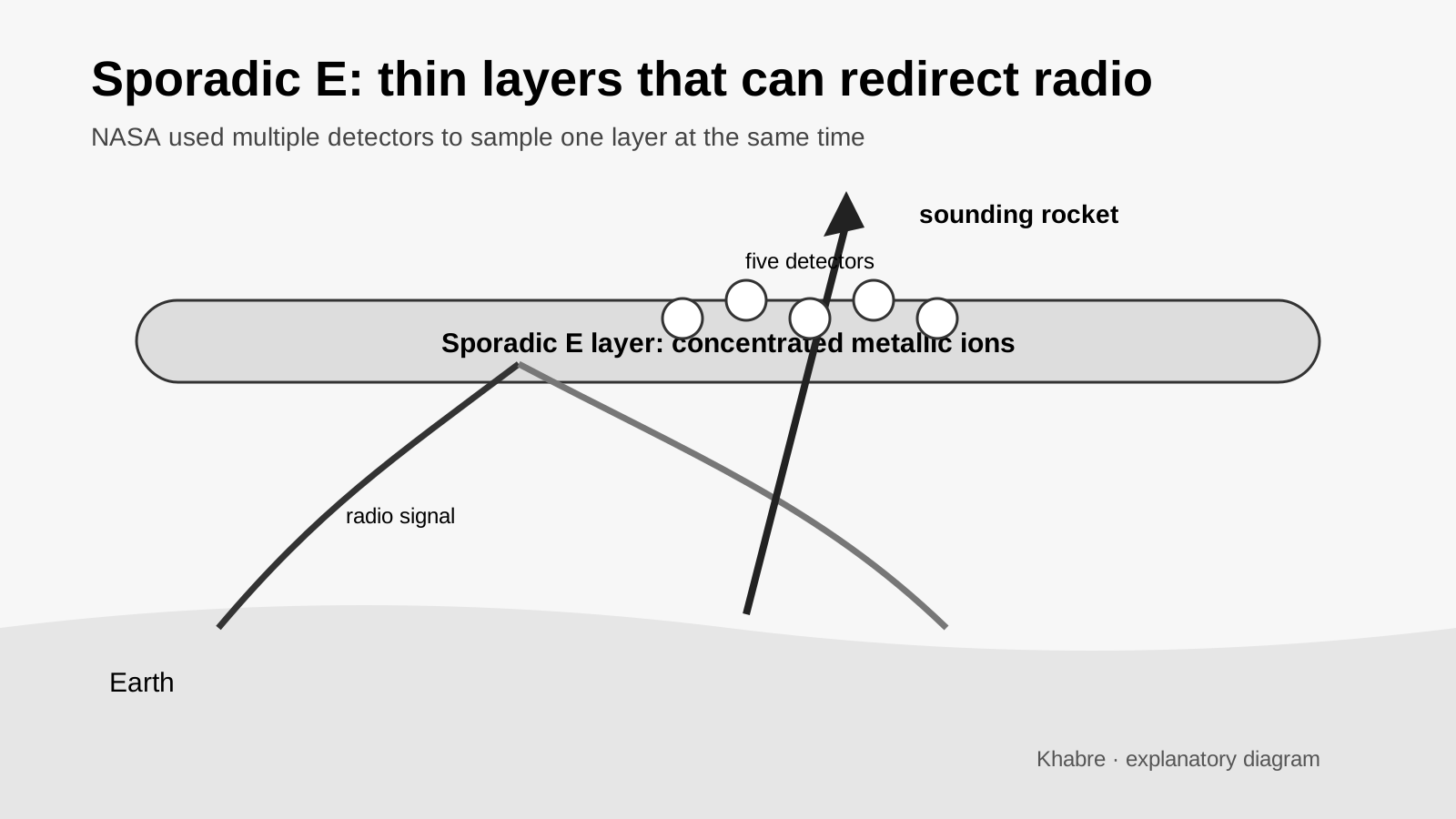
NASA researchers have obtained the first simultaneous multi-point measurements from inside a sporadic E layer, a thin metallic layer high in Earth's atmosphere that can unexpectedly reflect radio signals and disrupt long-distance communications.
The measurements came from a sounding rocket that carried five detectors through the layer at the same time. NASA says the experiment revealed internal complexity that earlier single-path measurements could not show.
Contents
- What sporadic E layers are
- Why they affect radio signals
- What the rocket experiment changed
- Why multi-point measurements matter
- Where the metallic ions come from
- Why the result matters
What sporadic E layers are
Sporadic E layers form in the ionosphere, a region of the upper atmosphere where solar radiation creates electrically charged particles.
These particular layers contain concentrations of metallic ions at altitudes where the atmosphere is extremely thin.
NASA describes them as thin, drifting clouds of metallic material. They are invisible to the eye but electrically important because charged particles can interact strongly with radio waves.
The “sporadic” name comes from their irregular appearance and disappearance, although researchers now understand that they have seasonal patterns and are more common under some atmospheric conditions.
Why they affect radio signals
Some radio frequencies can reflect from ionised layers in the upper atmosphere.
That effect is useful for long-distance communication because a signal can travel beyond the horizon by bouncing between the ionosphere and Earth's surface.
A dense sporadic E layer can create an unexpected reflecting surface. Signals may then travel along paths that engineers did not anticipate, producing interference, unusual propagation ranges or temporary loss of reliability.
NASA refers to these layers as giant radio-frequency mirrors in the sky.
What the rocket experiment changed
Previous sounding-rocket measurements usually sampled a narrow path through the layer.
That is like trying to understand the structure of a cloud by passing one thermometer through a single point.
The newer experiment deployed five detectors so researchers could measure conditions at several nearby locations at nearly the same time.
That matters because sporadic E layers are not static. If measurements are taken at different times, it can be difficult to tell whether differences are caused by location or by the layer changing between measurements.
Why multi-point measurements matter
Simultaneous measurements allow scientists to reconstruct horizontal and vertical structure more directly.
NASA says the new data revealed unexpected complexity inside the layer rather than a simple smooth sheet of ions.
That information can improve models of how winds, electric fields and charged particles interact in the lower ionosphere.
Better models could eventually improve forecasts of when and where sporadic E conditions are most likely to affect radio propagation.
Where the metallic ions come from
A striking part of the story begins with meteors.
Small pieces of extraterrestrial material continuously enter Earth's atmosphere and burn up. Vaporised metals from that material can become ionised and remain suspended at high altitude.
Atmospheric winds and electromagnetic forces can then concentrate those ions into relatively thin layers.
The result is a structure made partly from meteoric material but shaped by Earth's atmosphere and magnetic environment.
Why the result matters
Researchers already know more about when sporadic E is likely to occur than they did decades ago. NASA notes that occurrence peaks during local summer in many regions.
The remaining scientific questions are increasingly about fine structure: how the layers form, how they break apart and how their internal organisation affects radio propagation.
The new multi-point technique gives researchers a better way to answer those questions because it measures the layer as a spatial structure rather than as a single line through the sky.
That may help move sporadic E from an intermittent communications nuisance toward a phenomenon that can be modelled and predicted with greater confidence.
Primary source
- NASA Science. NASA Rocket Takes First Multi-Point Look Inside Radio-Disrupting Clouds. 2 September 2026. https://science.nasa.gov/science-research/heliophysics/nasa-rocket-takes-first-multi-point-look-inside-radio-disrupting-clouds/