A network of Indian radars and balloon-borne instruments has documented an unusual enhancement of ozone in the stratosphere over the north Bay of Bengal.
ISRO reported the finding on 26 August, based on a multi-institution campaign that combined ST/MST radar measurements with radiosondes and ozonesondes across several Indian locations. The work was subsequently published in Earth and Space Science.
The observation is notable because the ozone layer is not a uniform shell. Its concentration changes with altitude, atmospheric circulation and the movement of air masses. The campaign captured an event in which ozone concentrations rose substantially above the local climatological profile.
What the instruments found
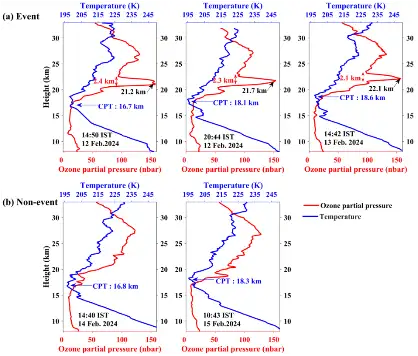
The researchers observed an enhanced ozone layer roughly 2.1 to 2.4 kilometres thick near the head of the Bay of Bengal.
According to ISRO, ozone partial pressure in the layer was elevated by about 50 nanobars above its climatological mean and the feature persisted for more than 24 hours.
The measurements came from a coordinated campaign involving Indian research institutions and radar sites at locations including Gadanki, Cochin, Haringhata and Nainital, together with balloon launches from multiple sites.
This combination matters because ozone concentration alone does not reveal why a layer formed. Radar observations of vertical air motion and turbulence can help reconstruct how air was transported.
What may have caused it
ISRO says the observations point to two plausible physical mechanisms: compression of an air mass, or advection and intrusion of ozone-rich mid-latitude air.
The radar network recorded strong upward motion in the upper troposphere and downward motion in the lower stratosphere at Haringhata, together with enhanced turbulence.
That pattern is consistent with a dynamically active boundary between atmospheric layers.
The result does not imply that ozone was suddenly being manufactured in isolation over the Bay of Bengal. Atmospheric transport can move ozone-rich air horizontally and vertically, changing the concentration measured over a region even when local chemistry is only part of the explanation.
Why stratospheric ozone matters
Most atmospheric ozone is in the stratosphere, where it absorbs a large fraction of biologically damaging ultraviolet radiation from the Sun.
Changes in ozone distribution can also alter the radiation balance and are linked to atmospheric circulation. Understanding short-lived regional anomalies therefore matters both for chemistry and for weather-climate interactions in the upper atmosphere.
The Bay of Bengal is especially interesting because deep convection can transport material from the lower atmosphere upward. At the same time, larger-scale circulation can bring in air from different latitudes.
What this does not mean
This event should not be interpreted as evidence that the global ozone layer has suddenly thickened, nor as a reversal of long-term ozone trends.
It was a regional, transient atmospheric structure observed during a specific campaign.
The scientific value lies in understanding how circulation and vertical motion can produce sharp local changes in ozone concentration, particularly over a convectively active region.
Why the Indian network matters
A single instrument can show that an anomaly exists. A network can help explain its geometry and motion.
By combining radar measurements of winds and turbulence with direct balloon profiles of ozone and temperature, the campaign could connect chemistry with atmospheric dynamics rather than treating them separately.
That is the broader significance of the result: not simply that ozone increased, but that multiple observing systems captured the processes associated with that increase.
Primary sources
- Indian Space Research Organisation. Unusual Stratospheric Ozone Enhancement Over the North Bay of Bengal: Insights from the Indian ST/MST Radar Network and Balloon-Borne Experiments. 26 August 2026. https://www.isro.gov.in/Unusual_Stratospheric_Ozone_Enhancement.html
- Original study: Earth and Space Science. DOI: 10.1029/2025EA004791.