Summary
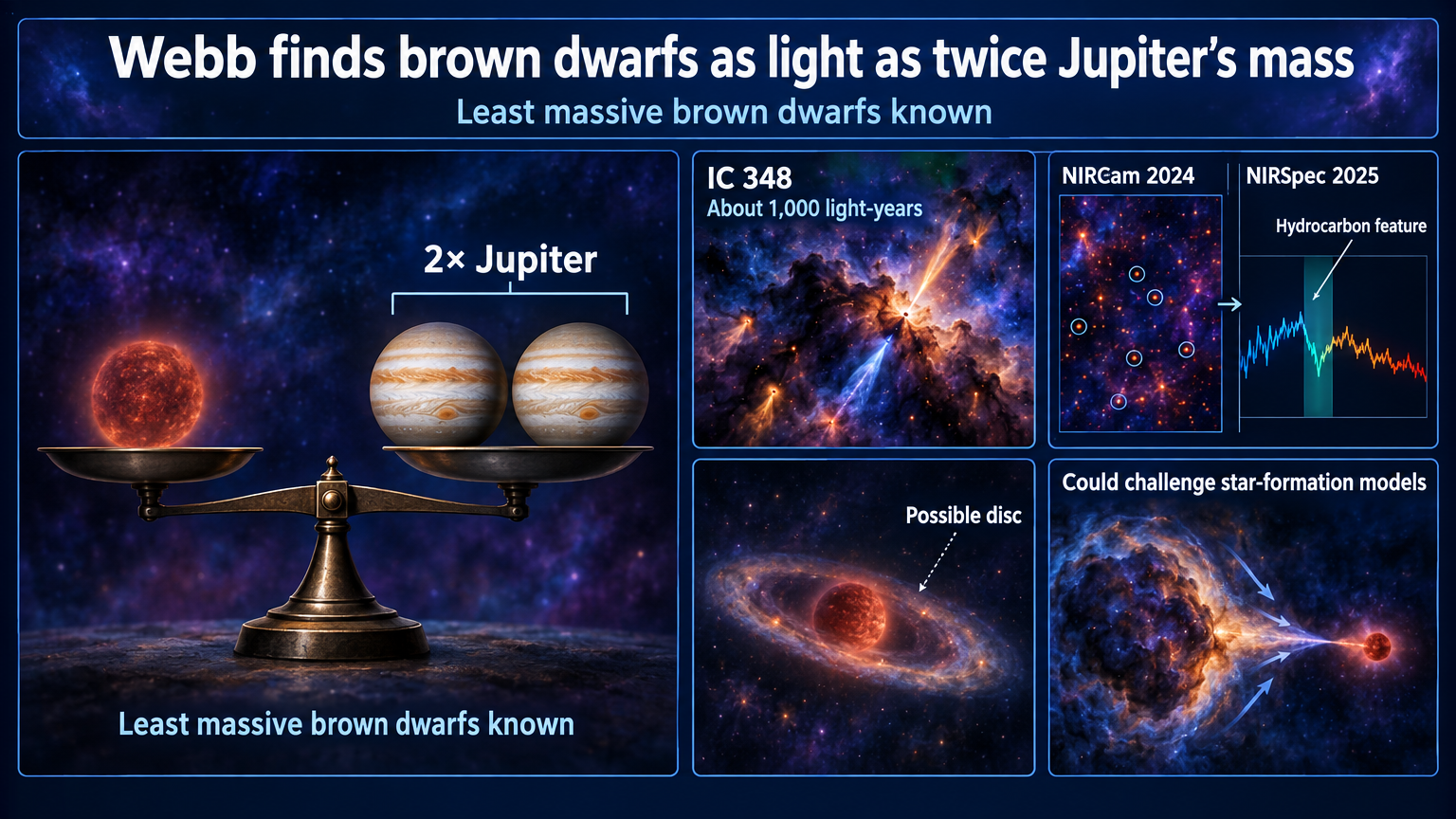
The James Webb Space Telescope has identified brown dwarfs in the star-forming region IC 348 with masses as low as twice that of Jupiter. The objects are the least massive brown dwarfs known and could challenge models of how stars form.
The James Webb Space Telescope has identified brown dwarfs with masses as low as twice that of Jupiter in the nearby star-forming region IC 348. The finding, announced by the European Space Agency on 15 September 2026, extends the known population of these objects into a lower mass range and presents a challenge for current models of how stars form.
IC 348 is about 1,000 light-years away in the constellation Perseus. The region contains a cloud of molecular hydrogen whose gravity is causing material to collapse into new stars. The resulting scene includes newborn stars, protostars, jets and glowing structures where outflows collide with surrounding gas and dust.
Brown dwarfs form through the collapse of molecular clouds, like stars do, but their cores never become hot enough to sustain the hydrogen-fusion process that powers ordinary stars. The smallest stars have about 8% of the Sun’s mass; objects below that threshold are generally classified as brown dwarfs. Some brown dwarfs can briefly fuse deuterium, a heavier form of hydrogen, early in their lives.
How Webb identified the objects
The research team first studied IC 348 with Webb in 2022 and found brown dwarfs with masses of roughly three to four times Jupiter’s mass. The new observations went deeper.
Webb’s Near-Infrared Camera, or NIRCam, captured the region in 2024. The team selected brown-dwarf candidates using their colours and brightness, then used Webb’s Near-Infrared Spectrograph, NIRSpec, in 2025. Spectroscopy spreads light into a spectrum, allowing astronomers to examine the objects’ properties and estimate their masses.
Those observations revealed brown dwarfs with masses as low as twice Jupiter’s mass, equivalent to 0.19% of the Sun’s mass. ESA describes these as the least massive brown dwarfs known. Their existence indicates that the star-formation process can produce objects substantially lighter than the brown dwarfs previously identified in this region.
The observations were made through Webb observing programme #4866, led by K. Luhman and C. Alves de Oliveira. The programme is studying the lowest-mass objects produced during star formation, how populations of planetary-mass objects differ between star-forming regions, and the origin of a hydrocarbon feature found in the atmospheres of the lowest-mass brown dwarfs.
A possible disc and an unusual atmospheric feature
One of the lightest newly identified brown dwarfs showed signs of a disc. Such a disc is material orbiting the object, and its presence suggests that planets could be forming around a body with a mass comparable to that of a planet itself. The observation is a clue about how planetary systems might develop around very low-mass objects.
The team also found a spectral feature attributed to hydrocarbons, molecules made only of hydrogen and carbon. ESA says this feature has previously been seen in the atmospheres of the lowest-mass brown dwarfs. Its presence in the IC 348 observations suggests that these extreme objects may belong to a distinct spectral class.
The wide Webb image also shows several protostars in the upper-right portion of the region. Some are associated with Herbig–Haro objects, luminous structures created when jets from growing stars strike nearby gas and dust. The feature known as HH 797 contains two protostars with nearly parallel outflows, while the nearby HH 211 includes narrow jets and broader outflows.
The new result combines near-infrared imaging with spectroscopic observations of a young stellar environment. By reaching brown dwarfs with masses only twice that of Jupiter, the study provides a more demanding test for theories describing how collapsing molecular clouds produce stars and substellar objects.