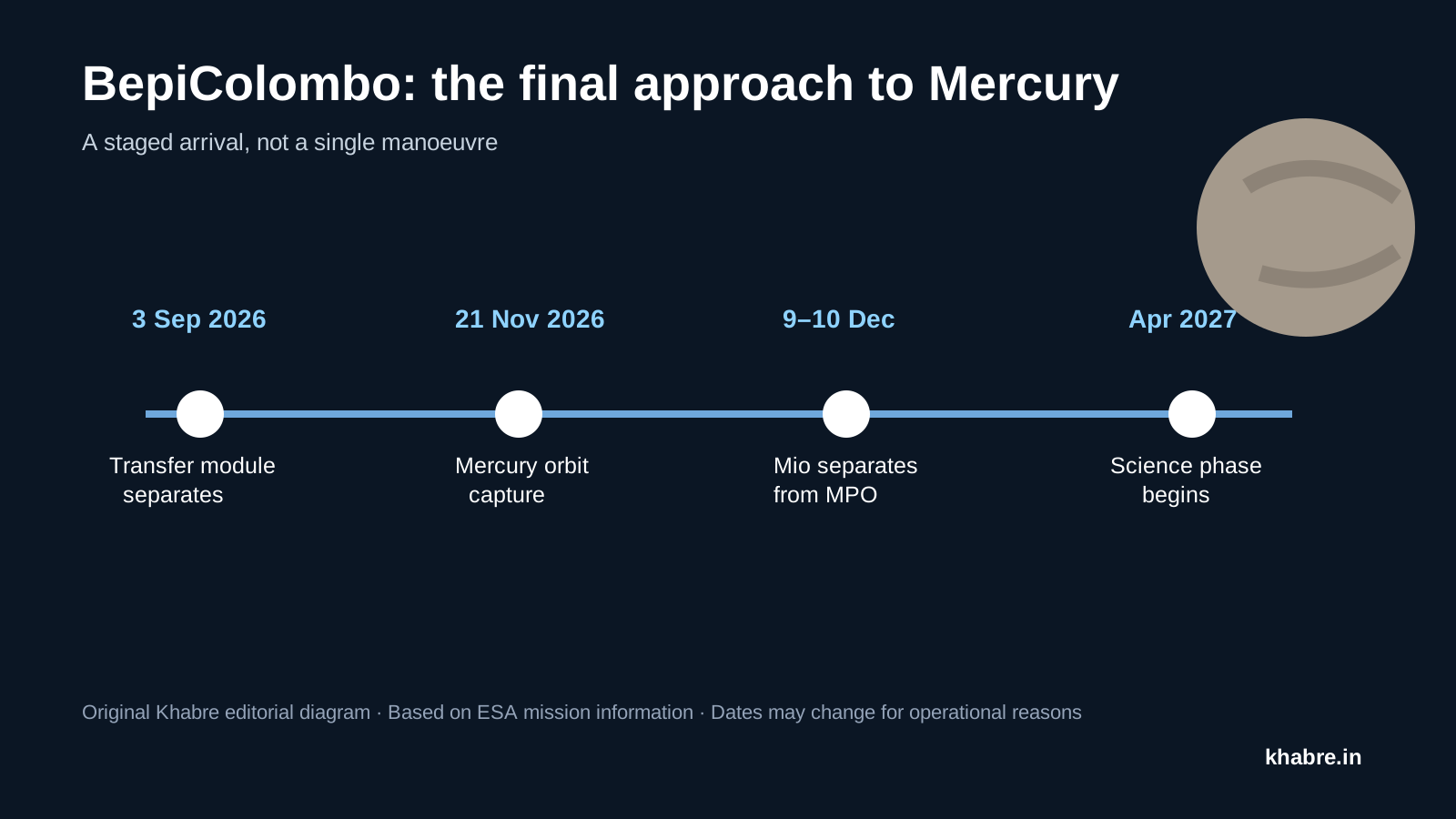
After almost eight years travelling through the inner Solar System, the ESA/JAXA BepiColombo mission has entered the sequence that will ultimately place two spacecraft into orbit around Mercury.
The European Space Agency confirmed on 3 September 2026 that BepiColombo's Mercury Transfer Module separated successfully from the spacecraft stack. Signal acquisition through ESA deep-space antennas in Spain and Argentina confirmed the separation, with telemetry indicating that the remaining spacecraft systems were nominal.
That event matters because the transfer module supplied propulsion during the long interplanetary cruise. From this point, ESA's Mercury Planetary Orbiter, or MPO, takes over the propulsion and control needed for the remaining approach.
Contents
- Why BepiColombo's arrival takes months
- What happened on 3 September
- The remaining arrival sequence
- Why Mercury is difficult to orbit
- What the two orbiters will study
- What happens next
Why BepiColombo's arrival takes months
BepiColombo is not a single science spacecraft. It was launched as a composite stack containing ESA's Mercury Planetary Orbiter, JAXA's Mercury Magnetospheric Orbiter — known as Mio — the Mercury Transfer Module and a protective sunshield for Mio.
The transfer module carried the stack across the Solar System using solar-electric propulsion. Once that job was complete, the mission had to change configuration before Mercury orbit insertion.
ESA's current timeline calls for the remaining stacked spacecraft to be captured into a polar orbit around Mercury on 21 November 2026. MPO is then scheduled to release Mio on 9–10 December. Mio's sunshield is to be discarded on 16 December, after which MPO will gradually descend toward its own operational orbit.
MPO is expected to reach its final orbit in March 2027, with the main science phase beginning in April 2027. ESA notes that exact operational dates can change.
What happened on 3 September
The 3 September separation was performed more than 200 million kilometres from Earth. At that distance, controllers cannot respond to events in real time; commands and contingency planning have to account for the communications delay.
After the transfer module separated, ESA acquired BepiColombo's signal using its Cebreros station in Spain and Malargüe station in Argentina. ESA reported that MPO's solar arrays were charging its batteries and that spacecraft systems were nominal.
The separation also marked the end of the configuration in which the mission had spent most of its cruise. BepiColombo launched in October 2018 and used a sequence of planetary flybys and sustained ion propulsion to reshape its orbit around the Sun.
The remaining arrival sequence
Mercury arrival is deliberately staged rather than treated as one manoeuvre.
21 November: orbit capture
MPO and Mio are scheduled to enter a highly elliptical polar orbit while still attached to each other. This is the point at which BepiColombo becomes a Mercury orbiter rather than an interplanetary spacecraft approaching the planet.
9–10 December: Mio separates
JAXA's Mio orbiter will be released into its own elliptical polar orbit. Mio is designed primarily to study Mercury's magnetic environment, plasma and the interaction between the planet and the solar wind.
December to March: MPO descends
ESA's MPO will then perform additional manoeuvres to reach a lower polar orbit suited to detailed remote sensing and geophysical measurements.
Why Mercury is difficult to orbit
Getting close to the Sun does not simply mean falling inward. A spacecraft launched from Earth already shares Earth's high orbital speed around the Sun. Reaching Mercury requires shedding a large amount of orbital energy while avoiding excessive propellant use.
BepiColombo addressed that problem with nine planetary flybys during its cruise: one at Earth, two at Venus and six at Mercury. Each encounter altered the spacecraft's trajectory through gravity assistance.
The environment is also demanding after arrival. At Mercury, sunlight can be several times more intense than at Earth, creating severe thermal constraints for spacecraft structures, electronics and solar arrays.
What the two orbiters will study
The mission uses two orbiters because Mercury's surface, interior and surrounding space environment are closely connected but require different measurement strategies.
MPO carries instruments for imaging, spectroscopy, surface composition, topography, gravity and magnetic-field measurements. These observations can help investigate Mercury's unusually large metallic core, volcanic and tectonic history, surface chemistry and permanently shadowed polar regions.
Mio focuses on the magnetosphere. Mercury has a global magnetic field despite its small size and slow rotation. The planet's magnetosphere is compressed strongly by the solar wind because Mercury lies so close to the Sun.
Operating the two spacecraft simultaneously will allow researchers to distinguish changes occurring at different places from changes happening over time — an important advantage when studying a rapidly varying plasma environment.
What happens next
The next major milestone is Mercury orbit insertion in November. Until then, mission controllers will continue navigation, spacecraft checkouts and preparations for the orbit-capture sequence.
BepiColombo will not begin routine science immediately after arrival. The spacecraft still need separation, orbit adjustment and instrument commissioning before coordinated observations begin in 2027.
The scientific payoff is potentially substantial: Mercury remains the least explored terrestrial planet in the inner Solar System, and BepiColombo will be the first mission to study it with two coordinated orbiters.
Primary sources
- European Space Agency. Latest updates: BepiColombo's arrival at Mercury. 3 September 2026. https://www.esa.int/Science_Exploration/Space_Science/BepiColombo/Latest_updates_BepiColombo_s_arrival_at_Mercury
- European Space Agency. BepiColombo arrival at Mercury timeline. Updated July 2026. https://www.esa.int/ESA_Multimedia/Images/2018/10/BepiColombo_arrival_at_Mercury_timeline